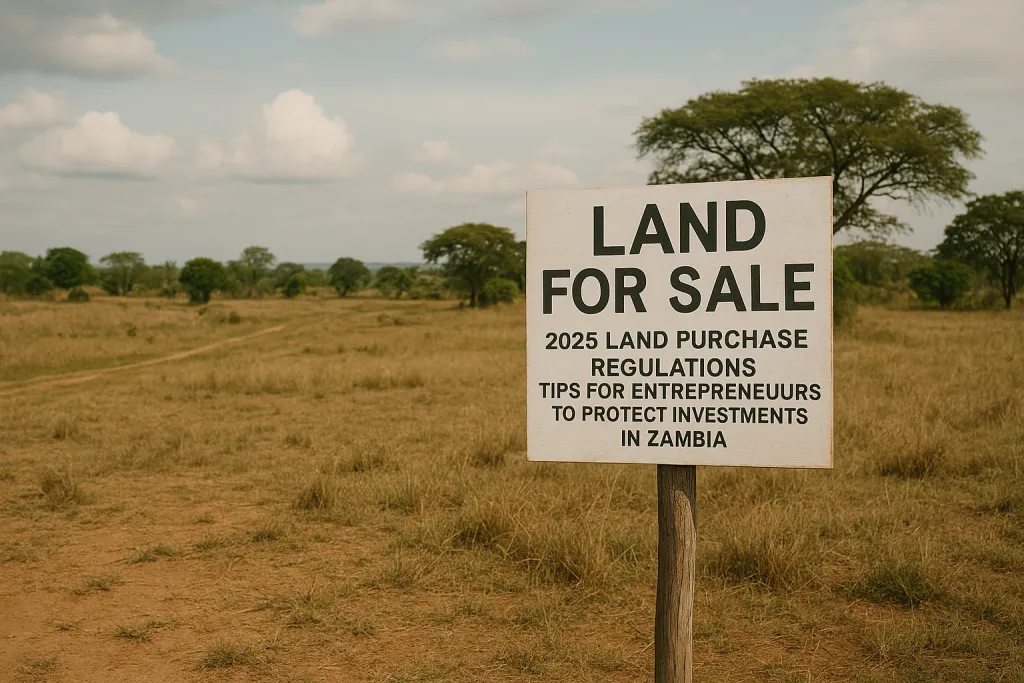
.png)

Foreigners can acquire property interests in Zambia, but only through the legal exceptions established under the Lands Act. A non-Zambian cannot simply identify a property, pay the seller and register the land without first proving eligibility to hold the lease.
The safest route depends on whether the buyer is a permanent resident, a qualifying investor, an eligible company or a person who has obtained written presidential consent. Buying property in Zambia as a foreigner therefore requires more than an ordinary conveyancing transaction. The buyer’s legal status must be resolved before money changes hands.
Key Takeaways
- Zambia does not operate a conventional freehold system. Land is generally held through leasehold title, commonly for terms of up to 99 years.
- A foreign national may acquire land only if they fall within an exception recognised under section 3 of the Lands Act.
- Registering a Zambian company does not automatically qualify that company to own land. The company’s ownership and investment status must be examined.
- State land with an existing title is generally easier to investigate and transfer than customary land requiring conversion.
- As of 2026, the Zambia Revenue Authority lists Property Transfer Tax on land at 8%, generally payable by the seller.
- A deposit of 10% is common in private transactions, but it is a contractual practice rather than a fixed statutory requirement.
- No buyer should pay a substantial deposit before an official lands search, seller verification and review of the remaining lease term.
How does land ownership work in Zambia?
Zambia’s land system is based on presidential control and leasehold tenure. The Lands Act provides that all land in Zambia is vested in the President and held in perpetuity for the people of Zambia. Individuals and companies therefore acquire rights to use and transfer land through leases rather than absolute freehold ownership.
A lease may run for up to 99 years, although shorter terms can apply. When buying an existing property, the buyer normally receives the balance of the seller’s lease rather than an automatic new 99-year term.
For example, if a title was granted for 99 years in 1997 and transferred in 2026, the purchaser may acquire only the remaining term. The buyer must inspect the title and confirm the commencement date instead of assuming that every purchase comes with a fresh lease.
Zambia has two broad land-tenure categories relevant to most buyers:
| Land category | How it is administered | Practical position for a foreign buyer |
|---|---|---|
| State land | Administered through the Ministry of Lands and Natural Resources and supported by registered title | Usually the more straightforward option where a valid title already exists |
| Customary land | Administered under customary tenure with the involvement of traditional authorities | Higher-risk unless the prescribed conversion, consent, planning and titling process is completed |
Protected forests, national parks, game management areas and other reserved areas may be subject to separate restrictions. “Reserve land” should not be treated as an ordinary third category of property available for private purchase.
A letter from a chief, headperson or local representative is not the same as a registered certificate of title. This distinction is one of the most important safeguards in land acquisition in Zambia.
Can foreigners own land in Zambia?
A foreigner may hold land in Zambia only when the transaction falls within a statutory exception. Nationality alone does not give a person the same land-acquisition rights as a Zambian citizen.
Under section 3 of the Lands Act, recognised routes include situations where the non-Zambian:
- Is a permanent resident of Zambia and holds the appropriate residence permit.
- Qualifies as an investor under the applicable investment legislation.
- Has obtained the President’s written consent.
- Acquires land through a company registered under the Companies Act in which less than 25% of the issued shares are owned by non-Zambians.
- Is an eligible statutory corporation or co-operative society.
- Is an approved non-profit, charitable, religious or educational organisation.
- Acquires land under another specific exception, including certain inheritance, banking or commercial circumstances provided by law.
The National Assembly reaffirmed these conditions in a ministerial statement delivered in March 2026. The restrictions therefore remain relevant to any current transaction.
The language commonly used in property advertising can be misleading. A house may be described as “available to foreigners”, but the property itself cannot determine the buyer’s legal eligibility. The proposed ownership structure must comply with the Lands Act.
Foreign buyers should obtain a written legal opinion on eligibility before signing an unconditional contract.
Which ownership route should a foreign investor use?
The best ownership route is the one that reflects the true purpose of the acquisition. A private residence, commercial development, operating factory and agricultural investment should not automatically be placed under the same structure.
| Buyer’s position | Possible route | Important consideration |
|---|---|---|
| Permanent resident | Purchase in the individual’s name | Residence status and supporting permit must be valid |
| Qualifying foreign investor | Investment structure supported by the Zambia Development Agency | The investment must meet applicable requirements and approvals |
| Foreign-owned operating company | Investor route or another approved statutory exception | Incorporation alone does not create land eligibility |
| Company with less than 25% foreign shareholding | Acquisition through the eligible Zambian-registered company | Beneficial ownership must be genuine and properly documented |
| Approved charity, religious body or educational institution | Acquisition through the registered body | Registration and ministerial approval requirements apply |
| Foreign beneficiary under an estate | Inheritance route, subject to applicable law | Probate, estate administration and land-registration requirements still apply |
The Zambia Development Agency confirms that foreign investors may own 100% of an enterprise registered in Zambia. That corporate right should not be confused with an unrestricted right to acquire land. The company must still satisfy the Lands Act through investor status or another recognised exception.
A nominee arrangement in which a Zambian citizen merely holds shares or property on behalf of a foreigner creates serious legal, tax and commercial risk. It can leave the real investor without enforceable control and may amount to an attempt to bypass land restrictions.
If you are considering a residential purchase, farm or commercial development in Zambia, establish the ownership route before negotiating the price. Book a foreign-investment and property-structure review with M&J Consultants. We assess the buyer, proposed use and holding structure before you commit capital.
What is the process for buying property in Zambia as a foreigner?
Buying property in Zambia as a foreigner should follow a controlled legal process. The transaction should move from eligibility and verification to contracting, tax clearance, consent and registration.
1. Confirm that the buyer is eligible
Determine whether the buyer will rely on permanent residence, investor status, an eligible company, presidential consent or another statutory exception.
Do this before paying a non-refundable reservation fee. If the buyer cannot legally hold the land, a valid title in the seller’s name will not solve the problem.
2. Identify the property and obtain its documents
Request copies of:
- The certificate of title
- The seller’s National Registration Card, passport or company documents
- The site plan or survey diagram
- Recent ground-rent records
- Local-authority rates clearance information
- Planning and building approvals
- Existing tenancy agreements
- Any mortgage, charge or security documents
If the seller is a company, conduct a company search and confirm that the person negotiating the sale has authority to act.
3. Conduct an official lands search
A lawyer should conduct a search through the Ministry of Lands and Natural Resources or the Zambia Integrated Land Administration System.
The search should confirm:
- The registered owner
- Property description and extent
- Title number
- Remaining lease term
- Mortgages, caveats or other encumbrances
- Restrictions on transfer
- Ground-rent position
- Whether the title details correspond with the physical property
The buyer should also inspect the site. A clean title search does not confirm that the boundaries on the ground are correct or that the property is free from occupation.
4. Investigate planning and physical risks
Confirm the approved land use with the relevant local authority. A residential title should not be assumed to permit a shopping centre, lodge, school, warehouse or manufacturing facility.
For land intended for development, investigate:
- Road access
- Water and electricity connections
- Sewerage or septic requirements
- Environmental approvals
- Building restrictions
- Wayleaves and servitudes
- Boundary beacons
- Informal occupants
- Flood, drainage and soil conditions
Agricultural, tourism and large-scale development projects may require additional sector approvals.
5. Sign a conditional contract of sale
The contract should state the purchase price, deposit, completion period, included fixtures, tax obligations and conditions that must be satisfied before completion.
Important conditions may include:
- A satisfactory official search
- Proof of the buyer’s eligibility
- Consent to assign
- Discharge of an existing mortgage
- Rates and ground-rent clearance
- Property Transfer Tax clearance
- Vacant possession
- Approval of subdivision, where applicable
A 10% deposit is common, but the percentage is negotiable. The deposit should preferably be held by the conveyancing lawyer as stakeholder until the agreed conditions are met.
6. Obtain consent and tax clearance
Depending on the title and transaction, consent to assign or other approval may be required from the Commissioner of Lands.
The seller must account for Property Transfer Tax to the Zambia Revenue Authority. Transfer documents cannot normally proceed to final registration without the required tax clearance documentation.
7. Register the transfer
The executed deed of assignment and supporting documents are lodged for registration. Ownership is completed through registration, not merely through payment, occupation or signature of the contract.
The purchaser should obtain the registered title or assignment documents and keep digital and physical copies of the complete transaction file.
How much does it cost to buy property in Zambia?
The purchase price is only one part of the cost. Buyers should budget for legal work, searches, government charges, valuation or survey work, local-authority clearance and possible financing costs.
As of 2026, the Zambia Revenue Authority lists the Property Transfer Tax rate for land, including buildings and improvements, at 8%. The tax is generally the seller’s liability and is based on the greater of the realised value and open-market value, subject to the applicable law.
| Cost | Normally paid by | Practical position |
|---|---|---|
| Purchase price | Buyer | Paid according to the contract |
| Property Transfer Tax | Seller | Current land rate listed by the Zambia Revenue Authority is 8% |
| Legal fees | Usually each party pays their own lawyer | Agreed with the lawyer and may attract VAT |
| Official searches and registration charges | Usually buyer | Depends on the documents and transaction |
| Valuation fees | Party requiring the valuation | Often required for tax, finance or due diligence |
| Survey fees | Buyer or seller by agreement | Relevant where boundaries or subdivision must be confirmed |
| Ground-rent and rates arrears | Usually seller before completion | Allocation should be stated in the contract |
| Mortgage and bank charges | Buyer | Apply where the acquisition is financed |
Worked example
Assume a foreign investor agrees to buy a titled commercial property in Lusaka for ZMW 2,000,000. An independent valuation also places the property at ZMW 2,000,000.
At an 8% Property Transfer Tax rate, the seller’s tax exposure would be:
ZMW 2,000,000 × 8% = ZMW 160,000
The buyer may separately pay legal fees, search charges, registration costs and valuation fees. If a 10% deposit is agreed, the deposit would be ZMW 200,000, but it would form part of the purchase price rather than an additional tax.
The buyer should not rely on an advertised “1% registration fee” as a universal rule. Government and professional charges depend on the transaction, instruments lodged and current fee schedules. Obtain an itemised completion statement from the conveyancing lawyer.
What are the biggest risks for foreign property buyers?
The greatest risk is not price. It is paying for property that the seller cannot lawfully transfer or that the buyer cannot legally hold.
Common mistakes include:
Treating company registration as automatic eligibility
A foreign investor may register a wholly foreign-owned company in Zambia. That does not automatically permit the company to acquire land outside the exceptions in the Lands Act.
Buying customary land through informal documents
A chief’s letter or local allocation document does not automatically create registrable leasehold title. Customary land acquisition may require local consultation, traditional authority involvement, council processing, planning checks and formal conversion.
Paying before conducting a search
Fraudsters may use copied titles, false powers of attorney or documents relating to another property. Payment should follow verification, not promises.
Ignoring the remaining lease term
The commercial value of a property may change significantly when the title has a short remaining lease period. The term must be checked during due diligence.
Using nominee shareholders or informal partners
A foreigner who puts property in another person’s name may lose both control and legal protection. Genuine joint ventures require shareholder agreements, governance controls and documented beneficial ownership.
Assuming the seller will clear every liability
The contract must allocate responsibility for taxes, ground rent, council rates, utilities, tenants and outstanding development obligations.
The objection we hear most often is: “The estate agent says the transaction is straightforward.” Estate agents help identify and negotiate property. They do not replace independent legal due diligence or determine eligibility under the Lands Act.
Conclusion
Buying property in Zambia as a foreigner is possible, but eligibility must be established before the ordinary transfer process begins. The law does not support informal shortcuts, nominee arrangements or the assumption that every Zambian-registered company can hold land.
Foreign buyers should prioritise titled state land, verify the seller through independent searches and make every deposit conditional on satisfactory legal due diligence. Customary land and development property require additional caution because title, boundaries, community rights and planning approvals may not yet be settled.
Before signing an offer or transferring a deposit, book a property and investment-structure review with M&J Consultants. We identify the lawful acquisition route, coordinate the required registrations and show you where the transaction carries avoidable exposure.
Frequently Asked Questions
Can a foreigner buy a house in Zambia?
Yes. A foreigner can buy a house in Zambia if the buyer qualifies under an exception in section 3 of the Lands Act. Relevant routes include permanent residence, qualifying investor status, an eligible company structure or written presidential consent. The buyer’s eligibility should be confirmed before signing an unconditional contract.
Can a foreigner own 100% of a Zambian company?
Yes. The Zambia Development Agency states that foreign investors may own 100% of an enterprise registered in Zambia. However, 100% corporate ownership does not give that company an unrestricted right to acquire land. The company must separately qualify under the Lands Act.
Is land in Zambia freehold or leasehold?
Land in Zambia is generally held under leasehold title rather than conventional freehold ownership. A common lease term is up to 99 years. A purchaser of an existing property normally acquires the remaining lease period shown on the title.
Who pays Property Transfer Tax in Zambia?
The seller is generally responsible for Property Transfer Tax on the transfer of land. As of 2026, the Zambia Revenue Authority lists the applicable rate for land at 8%. The calculation may use open-market value where it is higher than the declared consideration.
Is a chief’s letter proof of ownership?
No. A chief’s letter may form part of a customary land allocation or conversion process, but it is not equivalent to a registered certificate of title. Buyers should confirm the full conversion, planning, survey and registration requirements before paying for customary land.
Can foreigners buy farmland in Zambia?
A foreign investor may acquire rights to farmland if the investor qualifies under the Lands Act and completes the required acquisition process. Customary tenure, environmental approvals, water rights, community interests and the intended agricultural project may create additional requirements.