.png)
The best Smart Invoicing software in Zambia is Odoo for a growing business that wants more than tax compliance. Ecuenta is a strong option for smaller businesses looking for a locally focused accounting solution, Sage remains practical for companies already invested in Sage, while the Zambia Revenue Authority’s own Smart Invoice applications make sense for businesses that simply want to issue compliant invoices.
The mistake is choosing software purely because it can connect to ZRA.
Smart Invoice is a tax requirement. Your accounting or ERP system should also help you control sales, purchases, stock, cash, customers and operations.
As of August 2026, Zambia Revenue Authority provides four Smart Invoice routes: Mobile, Desktop, Online and integration of accounting or ERP systems through the Virtual Sales Data Controller, or VSDC. ZRA specifically describes VSDC integration as the route for taxpayers using accounting packages or enterprise resource planning systems.
That distinction should drive your software decision.
Key Takeaways
- Odoo is our overall winner because it can combine ZRA Smart Invoice integration with accounting, inventory, point of sale, CRM, purchasing, manufacturing, projects, HR and other business processes in one platform.
- Ecuenta is one of the strongest choices for a small Zambian business that prioritises straightforward Smart Invoice compliance and accounting.
- Sage remains sensible for existing Sage users. Zambia-specific providers such as ZamSmart connect Sage products to ZRA Smart Invoice without requiring businesses to replace their accounting system.
- ZRA’s own Smart Invoice applications are adequate if your requirement is primarily invoicing and tax compliance, but they should not be confused with a complete ERP.
- QuickBooks and Zoho Books are good accounting platforms, but their official product documentation does not currently show native Zambia Smart Invoice integration. A business should confirm a certified local connector before implementation.
- Palladium is a capable accounting and ERP platform, particularly around inventory and distribution, but businesses should verify the current Zambia Smart Invoice integration route before committing. Palladium’s official product material confirms extensive ERP functionality but does not document native ZRA Smart Invoice integration.
What should you look for in Smart Invoicing software in Zambia?
The right Smart Invoicing software should comply with ZRA requirements without forcing your finance team to duplicate transactions across separate systems. The invoice should originate from the same system that manages the underlying sale, customer, stock movement and accounting entry.
ZRA’s integration model makes this possible.
The Authority provides a VSDC interface specifically so Certified Invoicing Systems and ERP platforms can communicate with Smart Invoice. ZRA’s latest published VSDC API specification covers the exchange of transaction, branch, item and other data between third-party systems and Smart Invoice.
When comparing systems, we would assess seven things:
| Area | Why it matters |
|---|---|
| Smart Invoice integration | Can invoices flow to ZRA without re-entry? |
| Accounting | Does invoicing automatically update the books? |
| Inventory | Can stock purchases, movements and sales reconcile? |
| POS | Can retail transactions be fiscalised efficiently? |
| Business operations | Can sales, purchasing and approvals live in one system? |
| Scalability | Will the system still work when you add branches and users? |
| Local implementation | Who configures and supports Zambia-specific compliance? |
There is no single winner for every micro-business.
A consultant issuing six invoices a month does not need the same platform as a wholesaler managing three warehouses.
But once a business becomes operationally complex, the difference between invoicing software and business software becomes very important.
Which Smart Invoicing software is best in Zambia?
Here is our practical comparison of the systems most likely to appear on a Zambian business software shortlist.
The ratings below are SERPA Africa’s editorial assessment of overall business suitability, not ratings published by ZRA.
| Software | Smart Invoice | Accounting | Inventory/POS | Wider ERP | Best suited to | Overall |
|---|---|---|---|---|---|---|
| Odoo | ★★★★★* | ★★★★★ | ★★★★★ | ★★★★★ | Growing SMEs and larger organisations | 4.9/5 |
| Ecuenta | ★★★★★ | ★★★★☆ | ★★★★☆ | ★★★☆☆ | Small and medium local businesses | 4.3/5 |
| Sage + Smart Invoice connector | ★★★★☆ | ★★★★★ | ★★★★☆ | ★★★★☆ | Existing Sage businesses | 4.2/5 |
| Palladium | ★★★☆☆* | ★★★★★ | ★★★★★ | ★★★★☆ | Distribution and inventory-heavy SMEs | 4.0/5 |
| QuickBooks Online | ★★☆☆☆* | ★★★★☆ | ★★★☆☆ | ★★☆☆☆ | Small service businesses | 3.4/5 |
| Zoho Books | ★★☆☆☆* | ★★★★☆ | ★★★☆☆ | ★★★☆☆ | Small cloud-first businesses | 3.5/5 |
| ZRA Smart Invoice tools | ★★★★★ | ★☆☆☆☆ | ★★☆☆☆ | ★☆☆☆☆ | Basic compliance and low-volume invoicing | 3.0/5 |
*Integration or connector configuration must be confirmed for the specific implementation.
The table reveals the real question.
If all you need is “How do I issue a ZRA invoice?”, several products can solve the problem.
If the question is “What system should run my business and also handle Smart Invoice?”, the shortlist changes considerably.
Is Odoo the best Smart Invoicing software in Zambia?
Odoo is the strongest overall option for a growing Zambian business because Smart Invoice can sit inside a much wider ERP workflow instead of operating as an isolated tax application.
Odoo already has a Zambia fiscal localisation covering the country’s chart of accounts, taxes, fiscal positions and financial reporting. Odoo’s official documentation lists Zambia among its supported fiscal localisations.
For Smart Invoice itself, there is an important distinction.
Odoo should not be marketed as automatically ZRA Smart Invoice-ready straight out of a global installation. Zambia Smart Invoice communication must be properly configured through the ZRA VSDC integration process and an appropriate connector. ZRA requires ERP integrations to communicate through its certified Smart Invoice architecture.
Once configured, the advantage is that Smart Invoice becomes part of the transaction rather than an additional administrative job.
A sales workflow can look like:
Quotation → Sales Order → Delivery → Invoice → ZRA Smart Invoice → Payment → Accounting
The same transaction can also update customer balances, inventory and management reporting.
Then there is everything around the invoice.
Odoo can extend into:
- Accounting
- Sales and CRM
- Purchasing
- Inventory and warehousing
- Point of Sale
- Manufacturing
- Projects
- Field service
- Helpdesk
- HR
- Payroll through appropriate localisation
- E-commerce
- Approvals
- Multi-company reporting
That is why we rank Odoo first.
You are not purchasing a Smart Invoice application.
You are implementing a business management platform that happens to integrate Smart Invoice into the process.
If your team currently invoices in one system, tracks stock somewhere else and then captures information again for compliance, request an ERP readiness assessment from SERPA Africa. We map the transaction from quotation to ZRA reporting and show you which steps Odoo can remove before you commit to an implementation.
How does Ecuenta compare with Odoo for Smart Invoice?
Ecuenta is arguably the most straightforward competitor when Smart Invoice compliance itself is the priority. The company positions Ecuenta as ZRA-integrated accounting software and offers invoicing, accounting, inventory, POS, CRM and other business functions.
For a smaller business, that has obvious appeal.
You get a platform built around the Zambian market without necessarily taking on the broader scope of a full enterprise implementation.
Ecuenta therefore deserves serious consideration for:
- small retailers;
- service businesses;
- small wholesalers;
- businesses wanting cloud accounting;
- businesses mainly concerned with ZRA invoicing and bookkeeping.
Where Odoo begins to separate itself is depth and extensibility.
A business that starts with accounting and invoicing may later need advanced warehouses, manufacturing, CRM automation, maintenance, projects, procurement approvals, e-commerce or multiple companies.
Odoo is built around that wider ERP model.
The choice therefore comes down to ambition.
If the business is relatively straightforward and expects to remain straightforward, Ecuenta can be a convenient option.
If the business expects processes to become more sophisticated, we would rather implement a platform that can grow with those processes.
Worked example: the wholesaler with three branches
Consider a Lusaka distributor with branches in Lusaka, Ndola and Kitwe.
The business needs:
- Smart Invoice;
- three warehouses;
- purchase orders;
- stock transfers;
- landed costs;
- different sales teams;
- customer credit limits;
- approvals;
- CRM;
- branch profitability;
- consolidated reporting.
At this point, Smart Invoice is probably 10% of the software decision.
The other 90% is running the company.
That is where an ERP such as Odoo becomes much more compelling.
Is Sage a good Smart Invoice option in Zambia?
Sage remains a strong option for companies that already use Sage and do not have a wider reason to change ERP. Moving accounting systems solely to achieve Smart Invoice compliance would often create unnecessary migration risk.
ZamSmart, for example, provides a Zambia-specific interface connecting Smart Invoice with Sage products including Sage Pastel, Sage Business Cloud Accounting, Sage Pastel Xpress, Sage Pastel Partner and Sage Evolution. The provider specifically positions its solution as a way of avoiding duplicate and manual processing.
Other integration providers also offer ZRA e-invoicing connections for larger Sage ERP products such as Sage 300 and Sage X3.
That makes Sage particularly attractive where:
- the accounts are already clean;
- staff know the software;
- historical data is extensive;
- reporting works;
- inventory processes are stable;
- Smart Invoice is the main missing piece.
In that situation, keep Sage and integrate it.
But if the company already complains that Sage is only being used by finance while operations run through Excel, WhatsApp and paper approvals, Smart Invoice should not be the only issue considered.
That may be the right time to reassess the whole system.
Odoo’s advantage is not that Sage cannot do accounting.
Sage absolutely can.
Odoo’s advantage is how easily finance can become one part of an integrated sales, stock, procurement and operations platform.
What about Palladium, QuickBooks and Zoho Books?
Palladium is the strongest of these three for inventory-heavy operations, while QuickBooks and Zoho Books make more sense for smaller accounting-led businesses. Their Smart Invoice integration position, however, must be verified before purchase.
Palladium
Palladium is far more than bookkeeping software.
Its official product offering covers inventory, warehousing, distribution, POS, manufacturing, CRM, procurement, projects, multi-currency and mobile warehouse functionality.
For a wholesaler or distributor, that makes it a serious product.
Our reservation is specific to this article: Palladium’s official product documentation we reviewed does not clearly document native Zambia Smart Invoice integration.
That does not mean an integration is unavailable. It means a Zambian buyer should ask the implementation partner to demonstrate the live ZRA workflow rather than assume compliance from generic ERP capabilities.
QuickBooks Online
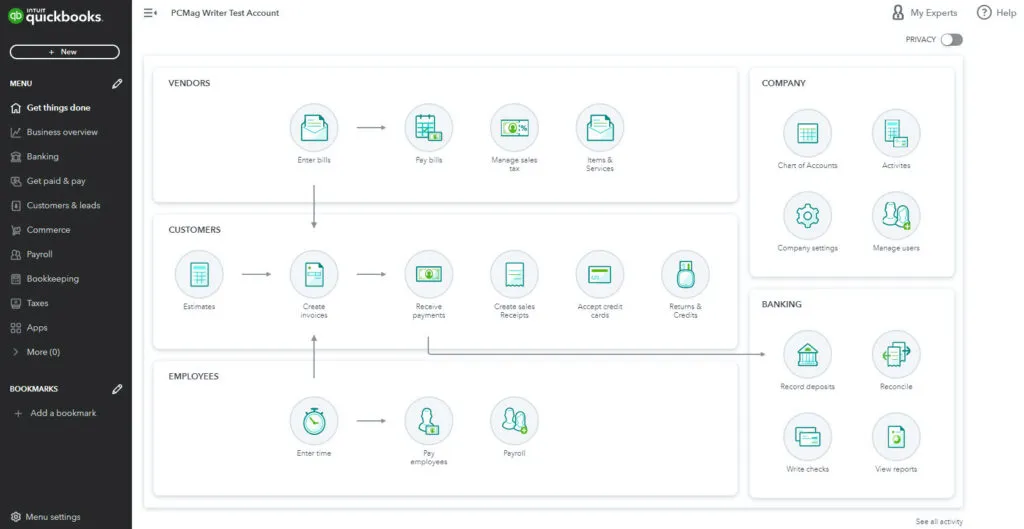
QuickBooks remains one of the world’s recognisable small-business accounting systems. Intuit’s global product supports invoicing, accounting, expense tracking and a large integration ecosystem.
What its official documentation does not currently demonstrate is native Zambia ZRA Smart Invoice integration.
A local third-party solution may bridge that gap, but that adds another dependency.
For a small service company already using QuickBooks, integration may still make commercial sense.
For a company selecting a brand-new platform specifically for Zambia, we would put ZRA integration higher on the shortlist criteria.
Zoho Books
Zoho Books is clean, cloud-based and strong for invoicing, accounts receivable, payables, bank reconciliation, automation and reporting. Zoho also has a wider ecosystem around CRM, inventory and other applications.
Zoho supports direct government e-invoicing integrations in some jurisdictions. Its official documentation, for example, documents country-specific e-invoicing regimes elsewhere.
We did not find equivalent official documentation for Zambia Smart Invoice.
That means Zambia-specific integration should be confirmed before adopting Zoho Books on the assumption that it will automatically communicate with ZRA.
Should a small business simply use ZRA Smart Invoice?
Yes, in some cases. ZRA’s own Smart Invoice tools can be the most convenient choice for a very small business that needs compliance rather than a complete accounting or ERP platform.
ZRA allows taxpayers to apply for the appropriate Smart Invoice type through its taxpayer portal. The available routes include Mobile, Desktop, Online and VSDC.
The Authority specifically describes different solutions for different taxpayer situations. Its Mobile solution, for example, is intended for Turnover Tax taxpayers rather than VAT-registered taxpayers.
So imagine a consultant who:
- provides one service;
- has no stock;
- has no POS;
- employs two people;
- issues ten invoices each month.
Implementing a full ERP purely for Smart Invoice would be excessive.
Use the appropriate ZRA solution and maintain proper accounting records.
Now compare that with a supermarket, manufacturer or distributor processing hundreds or thousands of transactions.
Capturing business transactions in operational software and then handling Smart Invoice separately creates unnecessary work.
Those businesses should be looking at integration, not additional data entry.
Which Smart Invoice software should your business choose?
The answer becomes easier when you start with the business instead of the software.
| Your business | Our recommendation |
|---|---|
| Micro-business needing basic compliance | ZRA Smart Invoice |
| Small local business prioritising easy invoicing/accounting | Ecuenta |
| Existing Sage company happy with its processes | Keep Sage + integrate |
| Inventory-heavy existing Palladium company | Keep Palladium if a proven connector is demonstrated |
| Existing QuickBooks service business | Consider integration rather than immediate migration |
| Existing Zoho ecosystem user | Verify Zambia connector before changing systems |
| Growing SME with multiple departments | Odoo |
| Retailer with POS + inventory + accounting | Odoo |
| Distributor with several warehouses | Odoo |
| Manufacturer | Odoo |
| Multi-branch or multi-company organisation | Odoo |
| Business planning serious digital transformation | Odoo |
“But isn’t Odoo more complicated?”
It can be.
That is the strongest objection to Odoo and it should not be hidden.
A system covering sales, accounting, inventory, procurement and manufacturing naturally requires more thought than a simple invoicing application.
Poorly implemented Odoo can become unnecessarily complicated.
That is an implementation problem, not an argument for keeping five separate systems.
The answer is to scope Odoo according to the business’s actual maturity.
A company can start with:
Accounting + Sales + Inventory + Smart Invoice
Then add other applications as the organisation is ready.
You do not need to digitise the entire business on Monday morning.
Final verdict: What is the best Smart Invoicing software in Zambia?
Our winner is Odoo.
Not because Odoo is the easiest way to generate one compliant tax invoice.
It isn’t.
If that is your only requirement, ZRA’s own tools or a locally focused product such as Ecuenta may be more convenient.
Odoo wins because businesses should not make a five-year software decision around a single compliance feature.
Smart Invoice is one transaction inside a much larger business process.
A customer enquiry becomes a quotation. The quotation becomes an order. The order affects inventory. Stock must be purchased. Goods are delivered. An invoice is generated. ZRA must receive the transaction. The customer pays. Accounting must reconcile it. Management needs to know whether the sale was profitable.
Odoo can manage that entire chain.
That is the difference.
The best Smart Invoicing software is not the system that simply sends an invoice to ZRA.
It is the system that sends the invoice to ZRA while helping you run the business that created the invoice in the first place.
For a serious growing Zambian company, our choice is Odoo.
If Smart Invoice has exposed how disconnected your sales, stock and accounting processes have become, request an Odoo readiness assessment with SERPA Africa. We map your current workflow, identify what should integrate with ZRA and recommend the smallest sensible Odoo scope. You see the process before committing to the implementation.
Frequently Asked Questions
What is the best Smart Invoicing software in Zambia?
For a growing business, Odoo is our overall choice because Smart Invoice can be integrated with accounting, sales, inventory, POS, purchasing and wider ERP processes. For a very small business focused mainly on tax invoicing, ZRA’s own Smart Invoice solution or a locally focused platform may be simpler.
Does Odoo work with ZRA Smart Invoice?
Yes, Odoo can be integrated with Zambia Revenue Authority Smart Invoice through the VSDC integration architecture. The Zambia fiscal localisation is supported by Odoo, while the Smart Invoice connector and ZRA configuration must be properly implemented for the specific deployment.
Can Sage integrate with ZRA Smart Invoice?
Yes. Zambia-specific solutions exist to integrate Sage systems with Smart Invoice. ZamSmart states that it connects Smart Invoice to products including Sage Pastel, Sage Business Cloud Accounting, Pastel Partner and Sage Evolution.
Is Ecuenta ZRA Smart Invoice compliant?
Ecuenta states that its accounting platform is ZRA-certified and integrated with Smart Invoice. Its Zambia offering combines Smart Invoice with accounting, inventory and POS functionality.
Does QuickBooks automatically connect to ZRA Smart Invoice?
Intuit’s official QuickBooks documentation reviewed for this guide does not document native Zambia Smart Invoice integration. QuickBooks can integrate with third-party applications generally, so an existing QuickBooks user should verify the availability and certification of a Zambia-specific connector before proceeding.
Do I need accounting software to use ZRA Smart Invoice?
No. ZRA provides its own Smart Invoice solutions, including Online, Desktop and Mobile options for appropriate taxpayer categories. Businesses already using accounting or ERP systems can instead apply for VSDC integration so their existing system communicates with Smart Invoice.