.png)
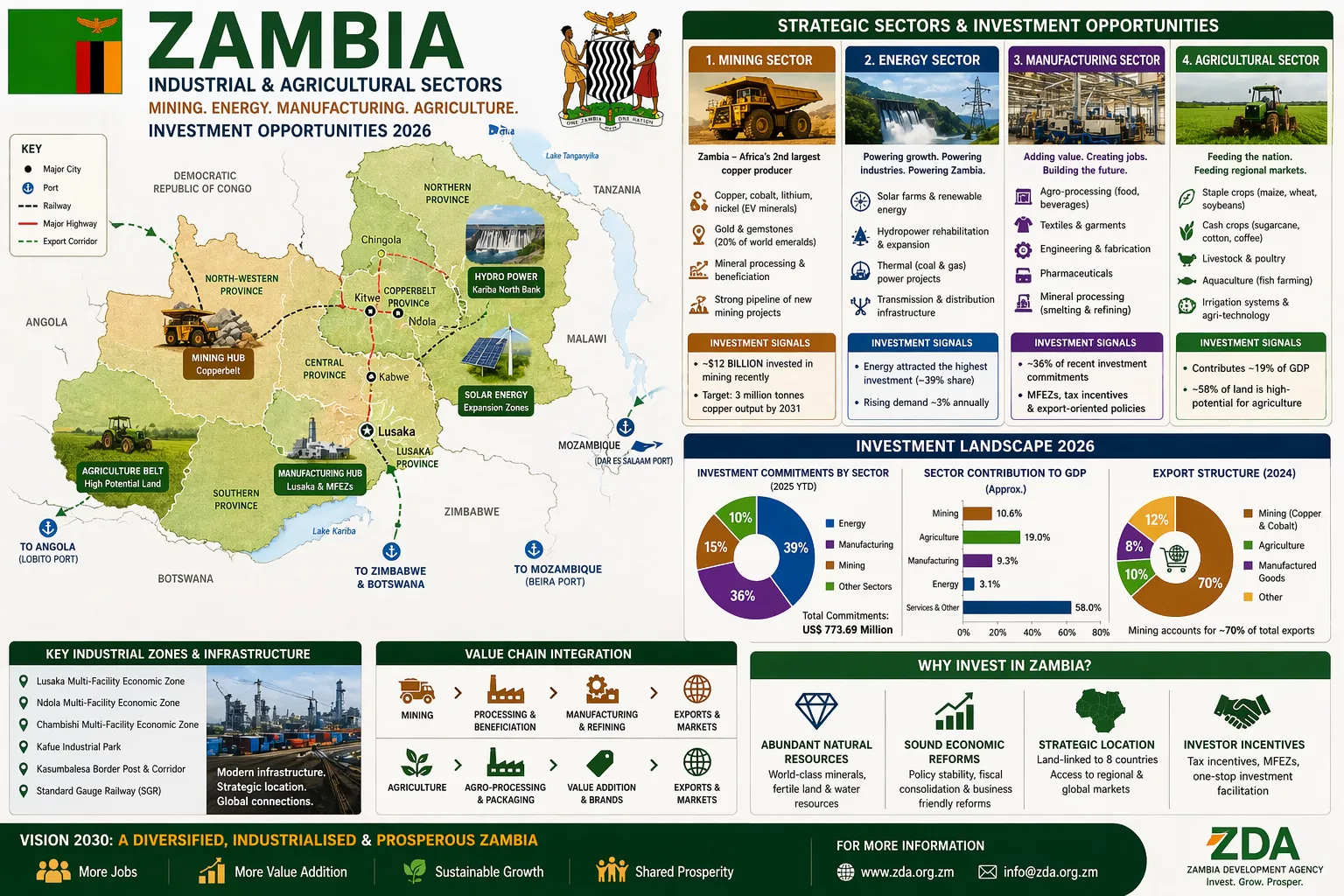
Introduction: Why Zambia’s Incentive Framework Matters in 2026
For investors evaluating Africa in 2026, Zambia stands out not just for its natural resources or strategic location, but for something more deliberate: a structured and sector-targeted incentive regime.
Across the continent, governments compete for capital through tax breaks and policy reforms. What distinguishes Zambia is how its incentives are aligned with specific sectors that drive economic growth. Rather than offering broad, unfocused concessions, the country has built a framework that channels investment into priority industries such as mining, agriculture, manufacturing, and energy.
This approach reflects a deeper shift in African investment policy. Incentives are no longer just about attracting capital. They are about shaping where that capital goes and how it contributes to long-term development.
For investors, particularly those in the diaspora, understanding these incentives is not optional. It is central to structuring profitable, compliant, and scalable investments.
The Legal and Institutional Framework Behind Zambia’s Incentives
Zambia’s investment incentives are primarily administered through the Zambia Development Agency, operating under the Investment, Trade and Business Development Act of 2022.
This framework establishes both fiscal and non-fiscal incentives tied to investment thresholds and sector classification. Investors who meet minimum capital requirements, typically starting at around $500,000 for foreign investors, can access a range of benefits including tax reductions, duty exemptions, and regulatory support.
In addition to fiscal incentives, the framework includes non-fiscal support such as investment protection guarantees, assistance with licensing, and facilitation of immigration permits for key personnel.
This dual structure is important. Tax incentives may improve returns, but non-fiscal incentives often determine whether a project is operationally viable.
Multi-Facility Economic Zones and Industrial Parks
Before examining sector-specific incentives, it is important to understand Zambia’s broader investment architecture.
Multi-Facility Economic Zones (MFEZs) and industrial parks serve as the primary vehicles for delivering incentives. These zones are designed to cluster investment, reduce operational costs, and streamline regulatory processes.
Investors operating within these zones benefit from zero percent tax on profits for the first five years, followed by reduced tax rates in subsequent years, as well as duty-free importation of capital equipment and machinery.
These incentives are not limited to a single sector. They provide a foundation upon which sector-specific benefits are layered.
Mining Sector Incentives: Aligning Policy with Resource Dominance
Mining remains the backbone of Zambia’s economy, particularly in copper production. The government has designed its incentive structure to both attract new investment and sustain existing operations.
Mining companies benefit from extended input tax claims on pre-production expenditure, allowing them to recover costs incurred during exploration and development phases.
Capital expenditure in mining is also treated favourably. Deductions on infrastructure, equipment, and development works reduce the overall tax burden and improve project viability.
One of the most significant incentives is the zero percent tax on dividends for mining companies. This enhances the attractiveness of the sector for investors seeking returns through profit distribution.
However, these incentives exist alongside a structured tax regime, including corporate tax and mineral royalty obligations. The balance reflects a policy objective of attracting investment while ensuring national revenue generation.
For investors, the key is understanding how these incentives interact with the broader fiscal framework.
Agriculture Sector Incentives: Lowering Barriers and Encouraging Scale
Agriculture plays a central role in Zambia’s economy, both as a source of employment and as a driver of rural development.
The government has introduced a wide range of incentives aimed at reducing entry barriers and encouraging large-scale investment.
Agricultural businesses benefit from a reduced corporate tax rate of around 10 percent, significantly lower than standard rates in many other sectors.
Capital investment in farming is strongly incentivized through allowances that cover infrastructure such as land clearing, irrigation systems, and soil conservation. These allowances enable investors to recover costs more quickly and improve early-stage cash flow.
Additional benefits include VAT deferment on imported equipment and zero-rating of key agricultural inputs, reducing upfront costs and improving operational efficiency.
Dividend exemptions for the first five years of operation further enhance returns, particularly for investors focused on long-term agricultural projects.
These incentives reflect a clear policy direction. Zambia is not just supporting subsistence agriculture. It is actively encouraging commercial and export-oriented farming.
Manufacturing Sector Incentives: Driving Industrialization
Manufacturing is a priority sector for Zambia as it seeks to move up the value chain and reduce reliance on raw material exports.
Incentives in this sector are designed to lower production costs and encourage capital investment.
Manufacturers benefit from input tax claims prior to the commencement of production, allowing them to recover VAT incurred during the setup phase.
Capital allowances on industrial buildings and machinery reduce taxable income and improve project returns. Investment allowances further enhance these benefits by providing additional deductions in the early years of operation.
Certain manufacturing activities, such as fertilizer production, benefit from reduced corporate tax rates, reflecting their strategic importance to the agricultural value chain.
Duty rebates on machinery and equipment, particularly within economic zones, further reduce capital expenditure requirements.
These incentives are part of a broader strategy to position Zambia as a regional manufacturing hub.
Energy Sector Incentives: Meeting Growing Demand
While the energy sector does not always receive the same level of explicit incentive breakdown as mining or agriculture, it remains a critical focus area for investment.
Demand for electricity and alternative energy sources in Zambia continues to grow, driven by industrial expansion and population growth.
Investments in energy infrastructure, particularly renewable energy projects, benefit from broader investment incentives available under the ZDA framework. These include duty exemptions on equipment, tax incentives within economic zones, and facilitation support for project approvals.
The strategic importance of energy means that investors often benefit from additional support at the project level, including public-private partnerships and long-term power purchase agreements.
For investors, the opportunity lies not only in generation but also in distribution, off-grid solutions, and energy services.
Cross-Sector Incentives and Strategic Advantages
Beyond sector-specific incentives, Zambia offers a range of cross-cutting benefits that enhance its overall investment appeal.
Duty-free importation of capital equipment reduces initial investment costs across all sectors. Accelerated depreciation allows investors to recover capital expenditure more quickly, improving project viability.
Investment guarantees provide protection against nationalization, reducing political risk and increasing investor confidence.
Facilitation services offered by the Zambia Development Agency streamline processes such as licensing, land acquisition, and immigration, addressing common operational challenges.
These cross-sector incentives create a supportive environment that complements sector-specific benefits.
Strategic Considerations for Investors
While Zambia’s incentive framework is attractive, it is not automatic.
Accessing these benefits requires meeting specific eligibility criteria, including minimum investment thresholds and sector classification. Investors must also ensure compliance with regulatory requirements and reporting obligations.
Understanding how to structure an investment to maximize available incentives is critical. This includes decisions around location, sector focus, and operational model.
Working with local advisors and engaging with the Zambia Development Agency early in the process can significantly improve outcomes.
Conclusion: Incentives Are Only as Valuable as Your Strategy
Zambia’s sector-specific incentives provide a powerful toolkit for investors, but they are not a substitute for strategy.
The country has created a framework that rewards investment in key sectors, reduces costs, and supports long-term growth. For investors who understand how to navigate this system, the benefits can be substantial.
However, incentives alone do not guarantee success. The real advantage lies in aligning these incentives with a well-structured investment strategy.
Call to Action: Turn Incentives into Competitive Advantage
If you are considering investing in Zambia, the opportunity is clear, but so is the need for precision.
Start by identifying the sector that aligns with your expertise and capital. Map out the incentives available and structure your investment to maximize them.
Engage with local advisors, verify eligibility requirements, and build a compliant framework from the outset.
Zambia’s incentive regime is designed to reward informed investors. The difference between average returns and exceptional outcomes often comes down to how well you understand and apply what is already available.