.png)

Introduction
Where a business chooses to locate its holding, company is one of the most consequential decisions its founders and investors will make. The choice affects how profits are taxed, how assets are protected, how easily shares can be transferred or sold, and how the entire corporate group is perceived by regulators, investors, and counterparties across multiple jurisdictions. Get it right, and the holding structure becomes a tool for efficient capital allocation and risk management. Get it wrong, and the structure becomes a source of unnecessary tax leakage, compliance friction, and missed opportunities.
Zambia is not Mauritius. It does not offer a zero-tax holding company regime, and it has never marketed itself as an offshore financial centre. What Zambia does offer, increasingly, is a combination of attributes that merit serious evaluation for businesses with genuine commercial operations in the region:
- Legal certainty under a modern Companies Act.
- Competitive tax rates with a growing treaty network.
- A geographic position at the centre of the SADC and COMESA trade blocs.
- Streamlined incorporation through digital government platforms.
This article examines the legal forms, tax rules, treaty advantages, and practical considerations that determine whether a Zambian holding company makes sense for a given business structure.
The Legal Starting Point: Corporate Forms Under the Companies Act
Any holding company discussion must begin with the available legal forms. Zambia’s Companies Act No. 10 of 2017 provides the statutory framework for incorporation, management, and governance of companies registered in Zambia.
Several corporate forms are available under the Act:
- Private company limited by shares.
- Public company.
- Company limited by guarantee.
- Unlimited company.
Private companies limited by shares are the most commonly used structure for holding entities, because they offer three specific advantages relevant to holding company purposes:
- Separate legal personality, distinct from shareholders.
- Limited liability for shareholders.
- Less stringent regulatory scrutiny than applies to public companies.
The choice of corporate form has immediate consequences. A private company limited by shares provides the flexibility to limit membership to no more than fifty shareholders, which suits closely held groups. A public company permits unrestricted share transferability but triggers additional regulatory and reporting obligations.
The Companies Act is administered by the Patents and Companies Registration Agency, which has modernized its processes significantly. Incorporation is now available through an e-Gov portal, with digital signatures accepted, making the process of establishing a Zambian holding company faster than at any point in the country’s history. For most regional holding structures, the private company limited by shares registered through the PACRA portal is the practical starting point.
The Tax Rules That Make Zambia Distinctive
The legal form provides the structure. The tax rules determine how efficiently that structure operates. Four features of Zambia’s tax system are particularly relevant for holding company analysis.
The Corporate Income Tax Framework
Zambia levies corporate income tax at a standard rate of 30 percent on resident companies. The rate has been stable across recent years, providing predictability for long-term holding structures. Sector-specific rates apply in certain cases:
- Mining companies are subject to 30 percent CIT but are also subject to mineral royalty tax, with rates varying by commodity and price level.
- The agriculture and non-traditional export sectors may qualify for reduced rates or special allowances.
For holding companies that do not trade actively, the relevant income streams are typically dividends, interest, and royalties received from subsidiaries. Each of these is subject to specific rules under the Income Tax Act.
The Property Transfer Tax on Shares
One of the most distinctive features of Zambia’s holding company regime is the property transfer tax treatment of share transfers. The key rules are as follows:
- Property transfer tax at 8 percent of the realized value applies to the transfer of shares in a company incorporated in Zambia.
- It also applies to the transfer of shares in a company incorporated outside Zambia that directly or indirectly owns at least 10 percent of the shares in a Zambian company.
- The realized value for indirect transfers is limited to the value of the effective shareholding in the Zambian entity, not the total value of the non-resident holding company.
This provision catches indirect transfers. If a non-resident holding company that holds a Zambian subsidiary is sold, the Zambia Revenue Authority has a statutory basis to collect property transfer tax on the value of the effective shareholding in the Zambian entity.
There are important exemptions to be aware of:
- Transfers of shares in publicly listed and traded companies are exempt.
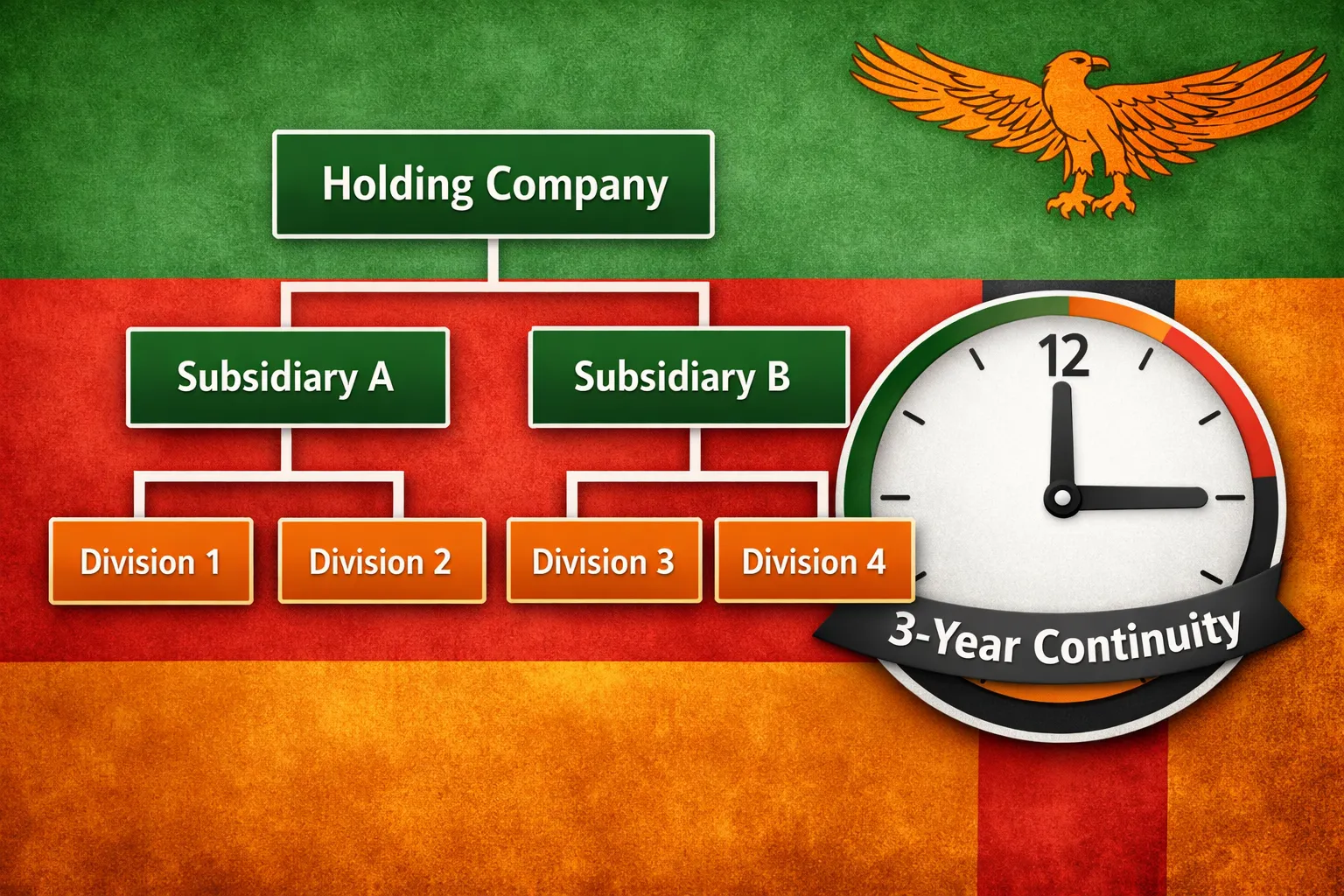
- Group reorganization’s where the shareholding in the Zambian entity does or does not change may also be exempt, provided the companies involved have been part of the same group for at least three consecutive years preceding the restructuring.
For holding company structuring, these rules require careful attention. Placing a Zambian operating subsidiary under a foreign holding company does not remove the property transfer tax exposure on ultimate exit. Understanding the interaction between the Zambian rules and the tax treatment in the jurisdiction where the holding company is located is essential.
Withholding Tax on Dividends, Interest, and Royalties
Zambia imposes withholding tax on dividends paid to shareholders. The applicable rates are structured as follows:
- Standard rate for residents: 15 percent.
- Standard rate for non-residents: 20 percent.
- A notable exception: dividends paid to an individual shareholder by a company listed on the Lusaka Securities Exchange are subject to zero percent withholding tax, regardless of whether the shareholder is resident or non-resident.
For other payment types relevant to holding structures, the standard rates are:
- Interest payments: 15 percent withholding tax.
- Royalties: 20 percent withholding tax.
These rates can be reduced under applicable double taxation agreements, which is where the treaty network becomes commercially valuable.
Consolidated Tax Grouping and Loss Relief
One limitation of Zambia’s tax system is that consolidated tax grouping is not permitted under the Income Tax Act. The practical implications for holding structures are significant:
- Groups of companies cannot utilize separate company losses across the group.
- Each company is taxed separately on its own taxable profits.
- A holding company structure with multiple operating subsidiaries cannot offset the losses of one subsidiary against the profits of another at the tax level.
This limitation does not prevent holding company structures from being efficient, but it does mean that tax planning must account for the standalone profitability of each entity in the group. Transfer pricing compliance becomes particularly important in this context, as intra-group charges directly affect the taxable position of each entity.
Double Taxation Agreements: The Treaty Network
Zambia’s network of double taxation agreements provides one of the strongest arguments for considering a Zambian holding company. The country has agreements with several key jurisdictions, including:
- South Africa.
- Mauritius.
- China.
- The United Kingdom.
- Germany.
- Several COMESA and SADC neighbours.
These agreements serve specific functions for holding structures. They reduce withholding tax on dividends from 20 percent to as little as 5 percent in treaty partner jurisdictions. They lower withholding on interest and royalties. They prevent the same profit from being taxed twice in two jurisdictions.
The UK-Zambia agreement illustrates the practical effect with specific reduced rates:
- Dividend payments: reduced to 5 percent for all companies except property-owning companies.
- Interest payments: reduced to 10 percent.
- Royalties: reduced to 5 percent.
- Fees for technical services: reduced to zero percent.
For a Zambian holding company receiving dividends from UK subsidiaries or paying dividends to UK shareholders, these reductions represent real cash savings.
The agreement with Mauritius is particularly significant for groups using Mauritius as an investment platform. Under the treaty, withholding tax on dividends can be reduced, and the interaction between Zambia’s domestic rates and the treaty rates creates structuring options that warrant professional analysis on a case-by-case basis.
Transfer Pricing: The Compliance Obligation
No discussion of Zambian holding company structures is complete without addressing transfer pricing. Zambia follows the OECD arm’s length principle, and the domestic framework is construed consistently with the OECD Transfer Pricing Guidelines and the UN Practical Manual on Transfer Pricing.
The compliance obligations are specific and enforceable:
- Local entities with annual net turnover of ZMW 50 million or more must prepare contemporaneous transfer pricing documentation.
- All multinational enterprises with related-party transactions are subject to the requirements regardless of this threshold.
- Documentation must be prepared annually and retained for ten years.
The enforcement environment has intensified. The Zambia Revenue Authority has focused its transfer pricing audits on the mining and consumer goods sectors. In the landmark Nestlé case, the Supreme Court of Zambia upheld the ZRA’s transfer pricing adjustments and established a critical evidentiary principle: the burden of proving a transaction complies with the arm’s length principle falls on the taxpayer once the ZRA has initiated an assessment.
For holding companies that charge management fees, royalty payments, or interest to Zambian operating subsidiaries, the practical implication is clear. Those intra-group charges must be supported by contemporaneous documentation that demonstrates they are consistent with what independent parties would have agreed. A safe harbour of cost-plus 5 percent applies to low-value-added intra-group services between associated persons.
Practical Considerations: Substance and Compliance
A holding company that exists only on paper is increasingly exposed to challenge. Tax authorities, including Zambia’s, are paying closer attention to economic substance requirements, particularly where treaty benefits are claimed.
The practical steps to establish and maintain a Zambian holding company with adequate substance are not complex, but they are specific:
- Appoint at least one Zambian resident director.
- Hold board meetings in Lusaka, with minutes maintained locally.
- Maintain a physical office and a registered address within Zambia.
- Operate a local bank account.
- Retain company records and tax filings at the registered office.
These measures are not expensive, and they provide the documentary evidence needed to demonstrate that the holding company is genuinely managed and controlled from Zambia.
The incorporation process itself has been streamlined into a predictable sequence:
- Name reservation through the PACRA e-Gov portal.
- Constitution filing and company registration.
- Registration with the Zambia Revenue Authority for tax identification and relevant tax types.
- For groups involving foreign direct investment, a Zambia Development Agency investment licence may provide additional benefits, including zero percent customs duty on capital equipment.
The full process can typically be completed within seven to fourteen working days.
Conclusion: A Question of Strategy
Zambia’s holding company regime is not for every business. Groups with no genuine connection to the Zambian or regional market will find little advantage in establishing a presence there. But for businesses with commercial operations in Southern and Eastern Africa, Zambia offers a combination of features that merit serious evaluation:
- The legal framework, anchored by the Companies Act, provides predictable corporate forms.
- The tax rules, including the property transfer tax on indirect share transfers, create both obligations and opportunities that must be understood early.
- The double taxation agreement network provides genuine cash savings for groups operating across treaty partner jurisdictions.
- The transfer pricing enforcement environment demands rigorous compliance, but the rules are clear and aligned with OECD standards.
The decision of where to locate a holding company is a strategic one, and it should be made with professional advice specific to the group’s structure, operations, and plans. Zambia is one jurisdiction that belongs on the shortlist for any business building a regional presence in Africa.
Call to Action:
The first practical step is a jurisdiction comparison. Request professional advice on the tax and legal implications of holding your Zambian operations through a Zambian holding company versus a holding company located in Mauritius, South Africa, or another jurisdiction under consideration. The analysis should cover four specific areas: corporate income tax, withholding tax on dividends, property transfer tax on exit, and treaty availability. That comparison, done before incorporation, can save multiples of its cost over the life of the structure.