.png)
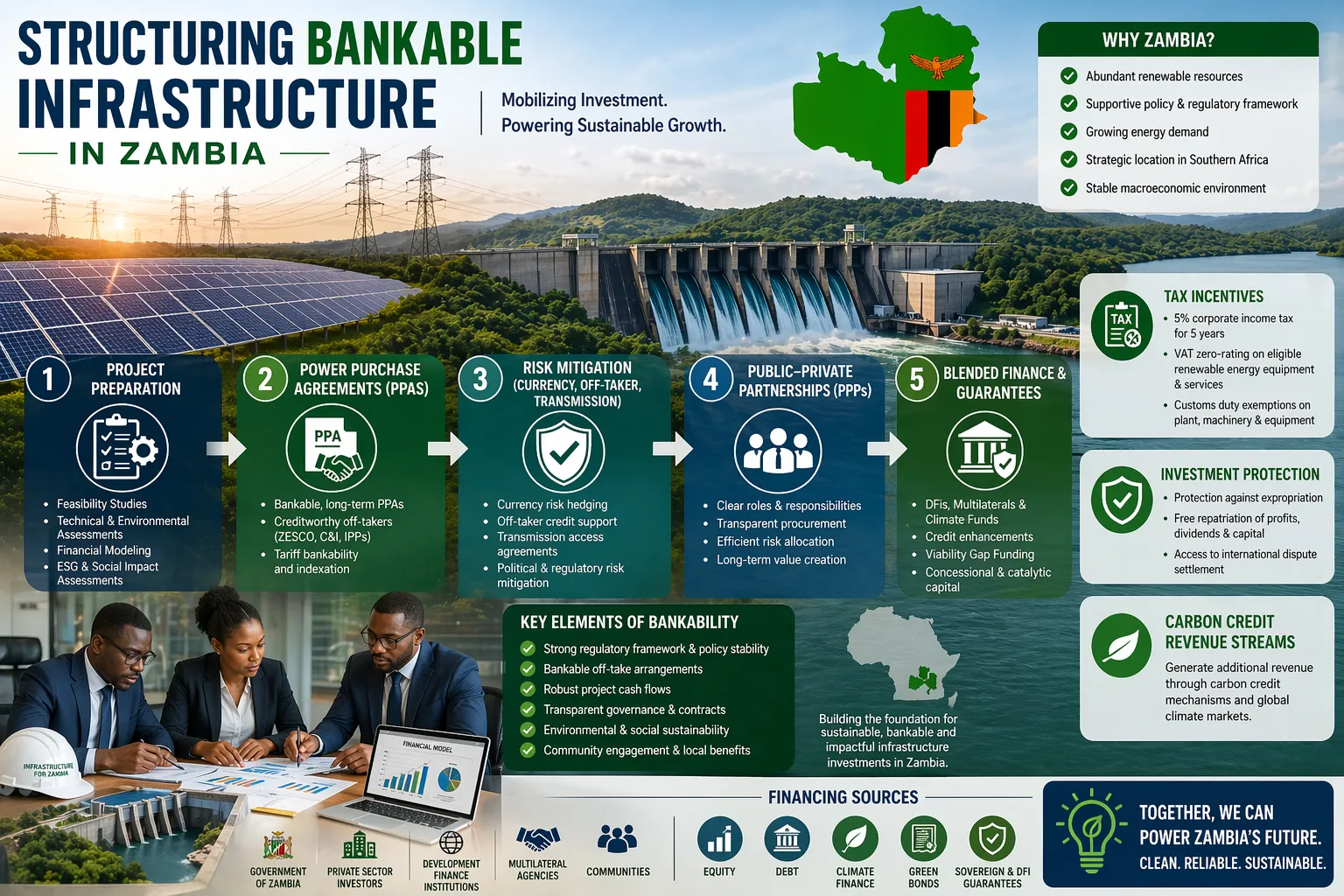
Introduction: From Pipeline to Bankability
Zambia’s infrastructure story is entering a new phase.
After years of debt constraints and stalled public investment, the government is doubling down on Public-Private Partnerships (PPPs) as the primary vehicle for delivering large-scale infrastructure. But the shift is no longer just about launching projects—it’s about structuring deals that can actually reach financial close.
The 2026–2027 pipeline reflects this transition: fewer headline announcements, more emphasis on bankability, governance, and execution discipline.
1. What Is Driving the 2026–2027 PPP Pipeline?
Fiscal Constraints Are Forcing Innovation
Zambia’s limited fiscal space means:
- Traditional public financing is constrained
- Private capital is no longer optional—it is essential
PPP is now central to infrastructure delivery, particularly in:
- Roads
- Energy
- Water systems
- Logistics corridors
Institutional Strengthening Is Underway
Recent initiatives—such as the PPP capacity-building program supported by the African Development Bank—aim to:
- Improve project preparation
- Strengthen procurement processes
- Enhance investor confidence
This signals a shift from project ambition → project readiness.
A Reformed Legal Framework
The Public-Private Partnership Act No. 18 of 2023 introduced:
- Centralized oversight through a PPP Office
- Clearer procurement pathways (solicited, unsolicited, direct)
- A structured project lifecycle from concept to handover
For investors, this reduces uncertainty—but increases scrutiny.
2. Where the Opportunities Are: Key Sectors in the Pipeline
Energy and Pipelines
Zambia is prioritizing energy security through major PPP-backed projects such as:
- Tanzania–Zambia Multi-Products Pipeline (TZMPP)
- Namibia–Zambia petroleum and gas pipeline
These multi-billion-dollar projects aim to diversify supply routes and reduce reliance on single corridors
Transport Infrastructure
Road PPPs remain active, including:
- Long-term concession-based road development projects
- Regional connectivity corridors
Example:
- A US$383 million road PPP in Copperbelt and Central Provinces with a 25-year concession structure
Logistics and Regional Trade Corridors
Emerging opportunities include:
- Rail link development
- Cross-border trade infrastructure
- Inland logistics hubs
These projects are increasingly structured to support regional integration, not just domestic mobility.
3. The Shift in 2026: From “Funded” to “Financeable”
One of the most important changes in Zambia’s PPP landscape:
Projects are no longer judged by announcement but by bankability.
Historically, some PPPs struggled due to:
- Weak feasibility studies
- Poor risk allocation
- Overreliance on public or quasi-public financing
In fact, concerns have been raised where PPPs were effectively funded by public pension institutions rather than true private capital
Today, the focus is on:
- Commercial viability
- Independent financing
- Robust project structuring
4. What Makes a PPP “Bankable” in Zambia Today?
1. Clear Revenue Model
Bankable projects must demonstrate:
- Predictable cash flows (tolls, tariffs, offtake agreements)
- Demand certainty or government-backed guarantees
Without this, financing will stall.
2. Optimal Risk Allocation
Zambian PPP guidelines emphasize:
- Allocating risk to the party best able to manage it
- Avoiding excessive transfer of risk to the private sector
Key risks include:
- Construction risk
- Currency risk
- Demand risk
- Political/regulatory risk
3. Strong Government Counterparty
Investors assess:
- Government credibility
- Contract enforcement history
- Payment reliability
Recent reforms to improve oversight and accountability are aimed at strengthening this confidence
4. Robust Feasibility and Preparation
The introduction of project development support mechanisms is critical:
- Government-backed feasibility funding
- Standardized project preparation processes
This reduces early-stage risk for investors.
5. Transparent Procurement and Governance
Transparency is no longer optional, it is a financing requirement.
Lenders expect:
- Competitive procurement
- Clear evaluation criteria
- Strong contract management frameworks
5. The Key Risks Investors Must Navigate
1. Execution and Quality Risk
Recent scrutiny of infrastructure quality has triggered:
- Tighter oversight
- Stronger enforcement mechanisms
Poor execution is no longer tolerated and contracts are likely to reflect that
2. Policy and Regulatory Evolution
As the PPP framework matures:
- Rules may evolve
- Compliance expectations may increase
Early investors must build flexibility into contracts.
3. Local Financing Dynamics
While PPPs aim to attract private capital, local realities include:
- Limited long-term financing markets
- Reliance on institutional investors
Structuring must align with available capital pools.
4. Currency and Macroeconomic Risk
Foreign investors must account for:
- Exchange rate volatility
- Convertibility risks
These factors directly affect project returns.
6. Structuring Strategies for Success
For developers, sponsors, and advisors, the difference between a stalled project and a bankable deal lies in structure.
Focus Areas:
- Blended finance models (DFIs + private capital)
- Phased project development to reduce upfront risk
- Government support mechanisms (guarantees, viability gap funding)
- Local partner integration to meet regulatory and operational requirements
The most successful deals will balance:
commercial viability + developmental impact
7. The Advisor’s Edge: Where Value Is Created
In Zambia’s current PPP environment, advisors are not optional—they are central.
Key advisory roles include:
- Financial modelling and bankability assessments
- Legal structuring and contract design
- Risk allocation frameworks
- Stakeholder and regulatory navigation
As the pipeline matures, execution quality, not deal volume will define success.
Call to Action: Position Early, Structure Smart
Zambia’s 2026–2027 PPP pipeline is not just an opportunity—it is a filter.
Only well-structured, financeable projects will move forward.
If you are an investor, developer, or advisor:
Now is the time to:
- Identify bankable sectors aligned with your expertise
- Engage early with project sponsors and government stakeholders
- Conduct rigorous feasibility and risk analysis
- Structure deals to meet lender expectations, not just policy goals
In Zambia’s PPP market, the winners will not be the fastest movers, they will be the best structured.
Conclusion: From Pipeline to Financial Close
Zambia is entering a more disciplined era of infrastructure development.
The PPP model remains central, but its success now depends on:
- Strong governance
- Real private sector participation
- Bankable deal structures
For those who understand this shift, the 2026–2027 pipeline offers genuine, investable opportunities.
For those who don’t, it will remain just that, a pipeline.