.png)
Introduction: A Budget in Transition
On 26 September 2025, Zambia’s Minister of Finance, Dr. Situmbeko Musokotwane, presented a K253.1 billion national budget to Parliament. The theme was aspirational: “Consolidating Economic and Social Gains towards a Prosperous, Resilient and Equitable Zambia.” But behind the theme lies a more complex story: a nation deliberately shifting from emergency stabilization to growth acceleration – with unusual policy transparency.
For four years, Zambia’s economic narrative was dominated by debt restructuring, IMF conditions, and fiscal firefighting. That chapter has now largely closed. Zambia became the first country to successfully restructure its external debt under the G20 Common Framework, reshaping its reputation from crisis‑prone to solution‑oriented. The 2026 budget is the first implemented after stabilizing the economy under the IMF‑supported Extended Credit Facility. The focus has shifted from fixing fundamentals to converting stability into growth, investment, jobs, and cost‑of‑living relief.
For investors and business leaders, this pivot is the signal that matters. When a government moves from survival mode to growth mode, its budget stops being a document of scarcity and becomes a roadmap of intention. Every allocation, tax incentive, and borrowing decision reveals where policymakers expect future economic value to be created. This article analyzes the 2026 Zambian budget through an investor’s lens.
The Macro Backdrop: From Stability to Growth
Any investment thesis must begin with the macroeconomic fundamentals. The headline numbers tell a story of momentum:
- GDP growth has averaged 5.2% over the past four years, absorbing COVID‑19 and the 2024 drought. The 2026 projection targets 6.4%.
- Inflation peaked at 16.7% in 2024, declined to **12.3%** by September 2025, with the Bank of Zambia targeting a return to the 6–8% band.
- The Kwacha appreciated by **14.7%** during 2025, driven by mining FX inflows and tight monetary policy.
- International reserves now cover more than four months of imports – a meaningful buffer.
For investors, declining inflation and a stabilizing currency reduce the uncertainty premium that has historically plagued Zambian asset pricing. In March 2026, the World Bank approved a US$45 million Development Policy Operation to support fiscal management, the investment climate, and climate resilience.
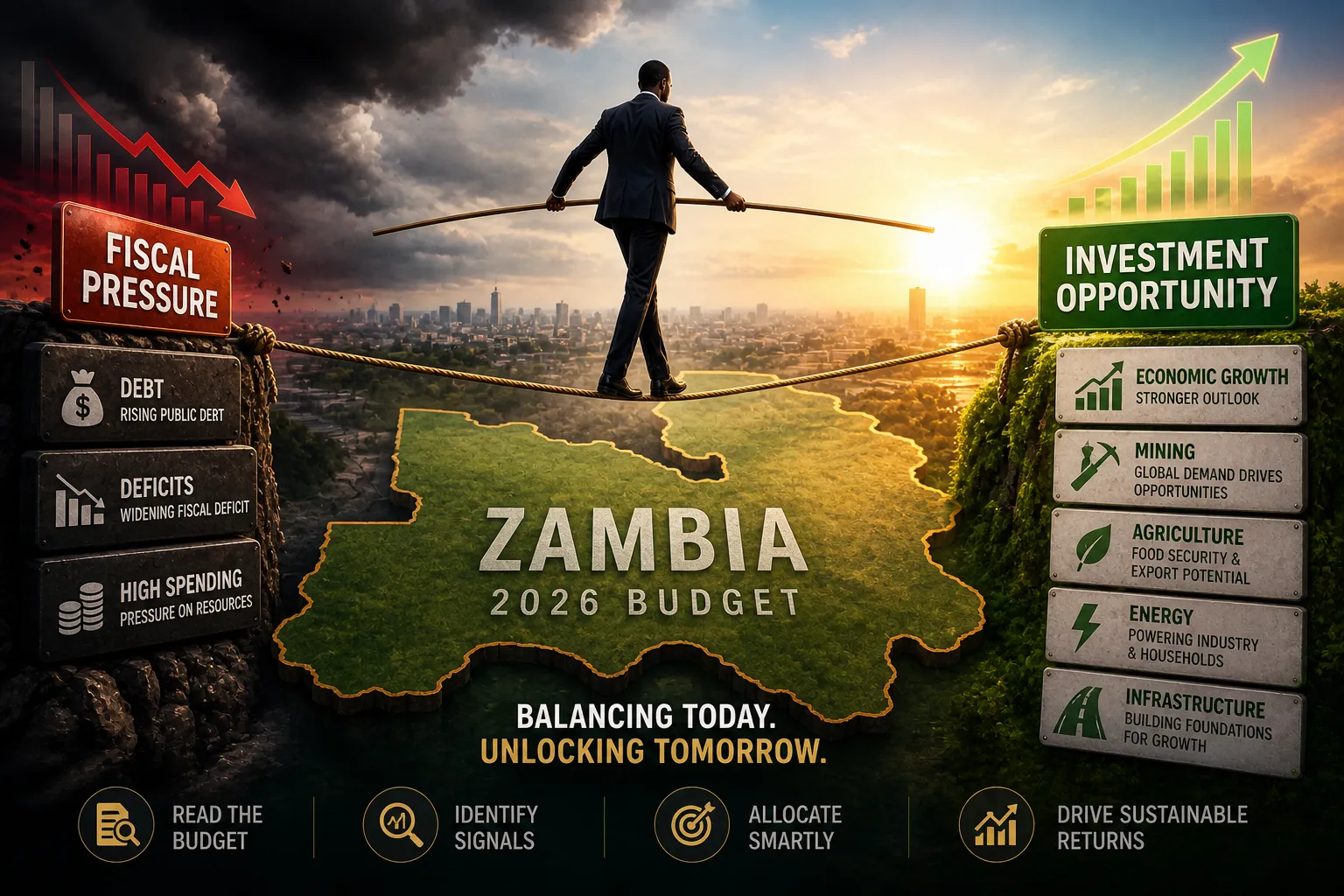
However, the tightrope remains. Debt service consumes a significant share of the budget:
- K52 billion → domestic debt servicing
- K21.7 billion → external repayments
- K4.7 billion → clearing arrears to local suppliers
These are non‑negotiable obligations that narrow fiscal space. The government is betting that growth, rather than austerity, will improve the debt‑to‑GDP ratio over time. Investors must assess whether they share that conviction.
The Five Signals: Where the Budget Points Capital
Reading a budget for investment insight requires looking past aggregate numbers to specific allocations and policy choices. Five signals stand out.
Signal One: Infrastructure as Productive Capital
The government treats infrastructure not as consumption spending but as productive capital. Of the K1.4 billion released for capital expenditure in January 2026 alone:
- K655.5 million → road infrastructure
- K440.2 million → cross‑ministry infrastructure development
- K201.9 million → water infrastructure projects
- K67.8 million → Rural Electrification Authority
The budget further proposes K1.1 billion for upgrading airports and border infrastructure, alongside continued progress on the Lusaka–Ndola Dual Carriageway and the Lobito and TAZARA railway projects.
Investor implication: Improved transport corridors reduce the cost of moving goods to market, benefiting agriculture, mining, and manufacturing. Construction companies, logistics providers, and businesses reliant on reliable transport infrastructure all stand to gain.
Signal Two: A Tax Regime Designed to Direct Capital
The 2026 budget introduced tax measures that function as a capital allocation mechanism – making some activities cheaper and others more expensive.
MSME and small‑scale mining relief:
- Turnover tax / rental income tax‑exempt threshold: K1,000 → K2,500 per month
- Artisanal mining turnover tax threshold: K800,000 → K5,000,000
- Late payment penalties: 5% → 0.5%
Energy sector incentives:
- Duty relief on machinery for electricity transmission and distribution
- Hydropower VAT refund period extended from 7 to 10 years
Agriculture and agro‑processing:
- Import duties on powdered milk, cheese, yoghurt, long‑life milk increased to 40% (protects domestic processors)
- Pasteurization machinery made duty‑free
- 2% local content allowance for value addition in milk and raw hides
- Zambia Credit Guarantee Scheme receives K851.7 million, including a Sustainable Agriculture Financing Facility
Climate‑conscious measures:
- Excise duty on new hybrid vehicles: 30% → 15%
- Duty on single‑use plastics: 30% → 100%
Signal Three: Energy Transition as Investment Mandate
The 2024 drought exposed the vulnerability of Zambia’s hydro‑dependent energy system. The budget response is a comprehensive push toward diversification.
- Proposed K500 million Electricity Allocation Fund in 2026 to support 100 on‑grid and 30 off‑grid renewable energy projects.
- By 2026, non‑hydro sources are projected to account for 33% of generation capacity.
- Government ambition to add over 1,500 megawatts to the grid – creating demand for project developers, equipment suppliers, and O&M providers.
- Rural Electrification Authority receives dedicated capital expenditure, signalling that off‑grid solutions are a priority.
For companies operating in remote areas, improved electricity access reduces reliance on expensive diesel generation. The extended VAT refund period for hydropower lowers a long‑standing friction for developers.
Signal Four: Human Capital as a Factor of Production
A budget that allocates significant resources to education and health is making a long‑term investment in workforce productivity.
- Education: K33.0 billion (10.3% of total budget) → recruits 3,500 additional teachers in 2026 (42,000 recruited since 2022), plus completion of 120 secondary schools and tertiary infrastructure at Copperbelt University and UNZA.
- Health: K26.2 billion → recruits 2,500 additional health personnel, with K6.4 billion specifically for drug procurement (30% increase from 2025) to maintain 90% drug availability.
**Investor implication:** A healthier, better‑educated workforce is more productive and requires less employer investment in remedial training and healthcare. The expansion of tertiary education signals a growing pipeline of skilled graduates.
Signal Five: Governance Reforms That Reduce Investment Risk
The budget’s most overlooked signals for investors are governance and institutional reforms that reduce long‑term policy risk.
- World Bank US$45 million operation structured around three pillars:
- Strengthening fiscal management (including disclosure of copper price assumptions and a Credit Risk Assessment Framework)
- Private sector development (operationalizing the PPP Project Development Support Fund and new PPP General Guidelines)
- Disaster risk management and climate resilience (unified early‑warning system, National Social Registry)
- State‑Owned Enterprises Bill advanced to strengthen oversight and reduce fiscal risks.
- K4.7 billion allocated to clear arrears owed to suppliers – restoring liquidity and rebuilding trust.
Where Opportunity Concentrates: The Sector Map
Synthesizing the budget signals produces a sector opportunity map for different risk appetites and time horizons.
- **Mining:** Copper output reached 820,676 tonnes in 2024, targeting 1 million tonnes in 2025 and 3 million by 2031. Improved fiscal transparency and the Lobito railway corridor enhance competitiveness.
- **Energy:** Opportunities from utility‑scale solar/wind to off‑grid solutions. A dedicated electricity fund, tax incentives, extended VAT refunds, and the urgency of Zambia’s power deficit create a policy environment unusually aligned with investor needs.
- **Agriculture & agro‑processing:** Higher dairy import duties protect domestic processors; duty‑free pasteurization machinery lowers upgrade costs; the local content allowance rewards value addition; the credit guarantee scheme and sustainable agriculture facility address farm finance.
- **Construction & infrastructure services:** Direct beneficiaries of K1.4 billion in capital releases, plus the CDF increase to K6.2 billion (K40 million per constituency) – a decentralized infrastructure spend reaching every part of the country.
- **Technology & digital services:** Supported by the Digital Zambia Acceleration Project (World Bank) procuring international internet capacity for government networks, creating demand for IT services and digital transformation solutions.
Principles for Allocating Capital in the Zambian Context
Five principles apply specifically to the Zambian opportunity.
- **Follow revealed priority, not stated priority.** The budget shows actual support: K851.7 million for agricultural credit guarantees, K500 million for the electricity fund, duty‑free machinery for both sectors – not rhetorical commitments.
- **Recognize ongoing fiscal constraints.** K52 billion for domestic debt service means the government will rely on private investment and PPPs for infrastructure. Investors who understand PPP frameworks will find a receptive counterparty.
- **Price climate risk explicitly.** The 2024 drought was not isolated. Budget allocations for energy diversification, early warning systems, and climate‑resilient agriculture are recognition that such shocks will recur.
- **Take MSME incentives seriously.** Increased tax thresholds and reduced penalties encourage formalization, expanding the addressable market for financial services, technology, and business services.
- **Maintain liquidity.** The government is making credible efforts to clear arrears, but the budget remains stretched. Avoid over‑concentration on public sector contracts and keep working capital reserves.
Conclusion: From Stabilization to Opportunity
Zambia’s 2026 budget is not merely a fiscal document. It is the financial expression of a country that has concluded one difficult chapter and is determined to write a different one. Debt restructuring is substantially complete. The IMF programme has restored credibility. Inflation is declining. The currency is stabilizing. International partners are re‑engaging.
The government’s own words capture the pivot: “Zambia is no longer stabilizing for its own sake; Zambia is positioning for growth.”
For investors, positioning for growth means reading the budget as a map:
- Roads, rails, and border infrastructure → logistics corridors of the future
- Tax incentives for energy, agriculture, manufacturing → sectors with sustained policy support
- Investments in education and health → the human capital that will staff enterprises
- Governance reforms → improved predictability and reduced policy risk
The fiscal tightrope remains narrow. But tightropes, walked deliberately, connect where you are to where you want to be. Zambia’s 2026 budget is a deliberate step across.
Call to Action:
Download the full 2026 Budget Speech from the National Assembly of Zambia website. Turn to the sections on tax measures and capital expenditure. Identify the three changes most relevant to your sector. Those changes are not just policy details – they are the government’s invitation to invest with confidence in specific parts of the Zambian economy. Begin your allocation analysis there.