.png)

The excitement of building a Zambian team is real. You have identified the talent. You have budgeted the salaries. You are ready to grow. But between that handshake and the first paycheque lies a regulatory landscape that catches many new employers off guard. Zambia’s employment framework is not designed to be a barrier. It is designed to protect workers and create a stable, predictable labour market. For the employer who understands the rules, compliance is straightforward. For the one who does not, the consequences can be severe.
The foundational law governing employment in Zambia is the Employment Code Act No. 3 of 2019. This comprehensive statute repealed and replaced more than a dozen older pieces of legislation, consolidating the rules around contracts, wages, leave, termination, and dispute resolution into a single, modern framework. It applies to all employers in Zambia, regardless of size, sector, or ownership structure. There is no exemption for small businesses. There is no exemption for start-ups. If you employ one person, the Code applies.
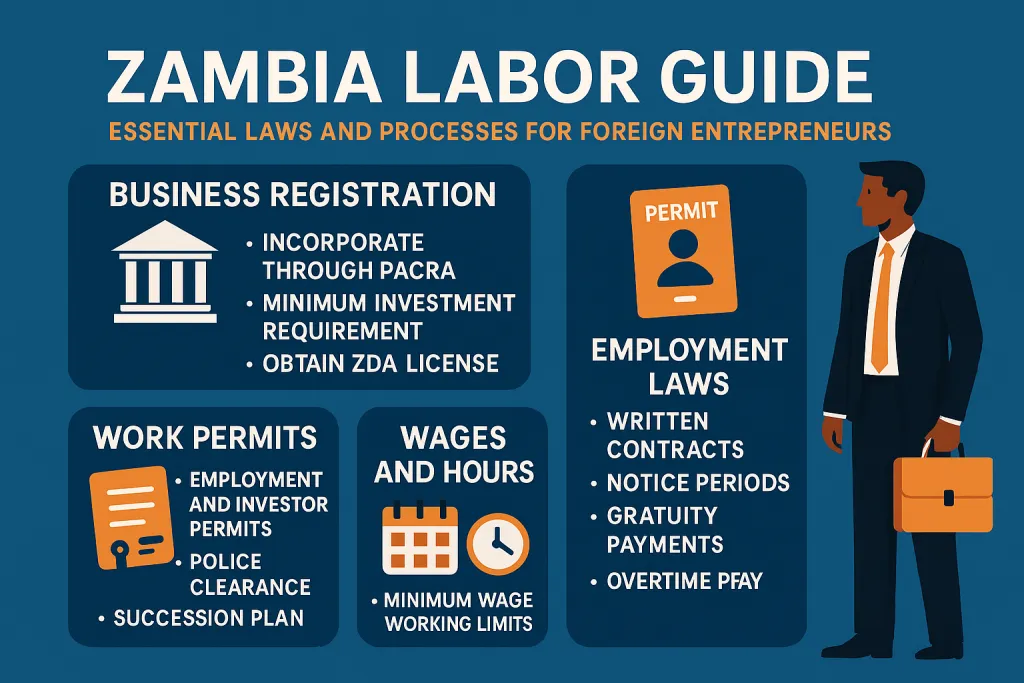
The employment contract is the cornerstone of the relationship. Zambian law requires that every employee be given a written contract within three months of starting work. For casual or temporary employees, the threshold is even lower. The contract must be in a language the employee understands and must specify the nature of the work, the place of work, the wage rate and method of payment, the hours of work, and the leave entitlements. An oral agreement or a vague email exchange does not satisfy the statutory requirement.
Contracts may be for a fixed term, for an indefinite period, or for a specific task. Fixed-term contracts are permissible but must be justified by the nature of the work. Rolling over fixed-term contracts indefinitely to avoid creating permanent employment rights is a practice that Zambian courts and labour officers view with increasing skepticism. The safer approach is to use indefinite contracts with a clear probationary period, which the Code permits for up to three months.
Probation is not a free pass. During probation, the employer may terminate the contract by giving not less than twenty-four hours’ notice. After probation, the notice period depends on the length of service. For employees with less than one month of service, twenty-four hours’ notice applies. For one month to three years, fourteen days’ notice is required. For three to five years, thirty days’ notice applies. For over five years, the notice period extends to forty-five days. These are minimums. The contract may provide for longer notice periods but not shorter ones.
The termination of employment is the area where employers face the greatest legal exposure. Zambian law protects employees from unfair dismissal. An employer may terminate a contract for reasons related to the employee’s conduct, capacity, or the operational requirements of the business. But the process matters as much as the reason. The Code requires that before terminating for conduct or capacity, the employer must follow a fair procedure. This means informing the employee of the allegations, giving them an opportunity to respond, and considering their response before deciding. Summary dismissal without any process, even for what appears to be gross misconduct, is a fast track to the Industrial Relations Court.
When termination occurs, the employer must pay all accrued benefits. This includes salary up to the last day worked, any accrued but unused leave days, and severance pay where applicable. Severance pay, known as redundancy pay, is due when termination results from the employer’s operational requirements, such as restructuring, closure of a department, or economic downturn. It is calculated based on length of service and is not payable when the employee resigns or is dismissed for misconduct.
The two statutory bodies that every Zambian employer must engage with are the National Pension Scheme Authority, known as NAPSA, and the National Health Insurance Management Authority, known as NHIMA. Both are mandatory. Both require registration before the first employee is hired. Both require monthly contributions that are shared between employer and employee.
NAPSA is Zambia’s national pension scheme. Every employer must register with NAPSA and deduct contributions from employees’ earnings. The current contribution rate is five percent of gross insurable earnings from the employee, matched by a five percent contribution from the employer. These contributions must be remitted to NAPSA by the tenth day of the following month. Failure to remit attracts penalties and interest. More importantly, a NAPSA compliance certificate is required for most government tenders and many private sector contracts. Non-compliance is not a private matter. It is a public disqualification.
NHIMA is the national health insurance scheme, launched to provide universal health coverage. Registration with NHIMA is mandatory for all employers. The contribution is one percent of gross insurable earnings from the employee, matched by a one percent contribution from the employer. Contributions are remitted monthly. Employees who are registered and up to date with their contributions are entitled to access health services at accredited facilities. Employers who fail to register or remit face penalties and may be pursued by the authority.
Beyond NAPSA and NHIMA, employers must also navigate the Workers’ Compensation Fund. This scheme provides compensation to employees who suffer occupational injuries or diseases. The employer bears the full cost of contributions, calculated as a percentage of gross insurable earnings, with the rate varying by industry risk profile. Registration is mandatory, and failure to register can result in the employer being held personally liable for the full cost of any workplace injury.
The minimum wage in Zambia is set by statutory instrument and varies by sector and category of worker. The government periodically revises these rates, and employers must stay current. Paying below the statutory minimum is a criminal offence. Wages must be paid in legal tender, directly to the employee, and at intervals not exceeding one month. Deductions from wages are strictly regulated. An employer may only deduct amounts required by law, such as NAPSA and PAYE, or amounts authorized in writing by the employee for specific purposes. Unilateral deductions for alleged damages, shortages, or disciplinary fines are generally unlawful.
Leave entitlements under the Code are generous by regional standards. Every employee is entitled to a minimum of twenty-four working days of annual leave per year. This leave accrues monthly and may be taken at times agreed between employer and employee. Sick leave is available for up to twenty-six weeks in any twelve-month period, with the first three months at full pay and the remaining period at half pay, subject to medical certification. Maternity leave is fourteen weeks, fully paid by the employer. Female employees are also entitled to one hour per day for nursing for up to six months after returning from maternity leave. Paternity leave is five days.
The role of the Ministry of Labour cannot be overstated. Labour officers have broad powers to inspect workplaces, investigate complaints, and issue compliance orders. An employee who believes their rights have been violated may lodge a complaint with the Labour Commissioner, who will attempt conciliation. If conciliation fails, the matter may be referred to the Industrial Relations Court. The process is designed to be accessible to employees, and employers who ignore labour officer inquiries do so at their peril.
For new employers, the most effective strategy is to front-load compliance. Before hiring, register with NAPSA, NHIMA, and the Workers’ Compensation Fund. Draft a compliant employment contract template that reflects the Code’s requirements. Establish a payroll system that calculates PAYE, NAPSA, and NHIMA correctly. Set calendar reminders for the tenth of each month to remit statutory contributions. Document all disciplinary processes in writing. These steps are not complex. They are simply non-negotiable.
Conclusion
The Zambian labour market offers immense opportunity. The workforce is young, increasingly educated, and eager to contribute. But the legal framework is protective, and the enforcement mechanisms are real. Employers who invest in understanding the rules from day one build stable, productive teams and avoid the costly disputes that plague those who treat compliance as an afterthought. The choice is clear. Build your team on a foundation of compliance, or spend your time and money fighting battles you could have prevented.