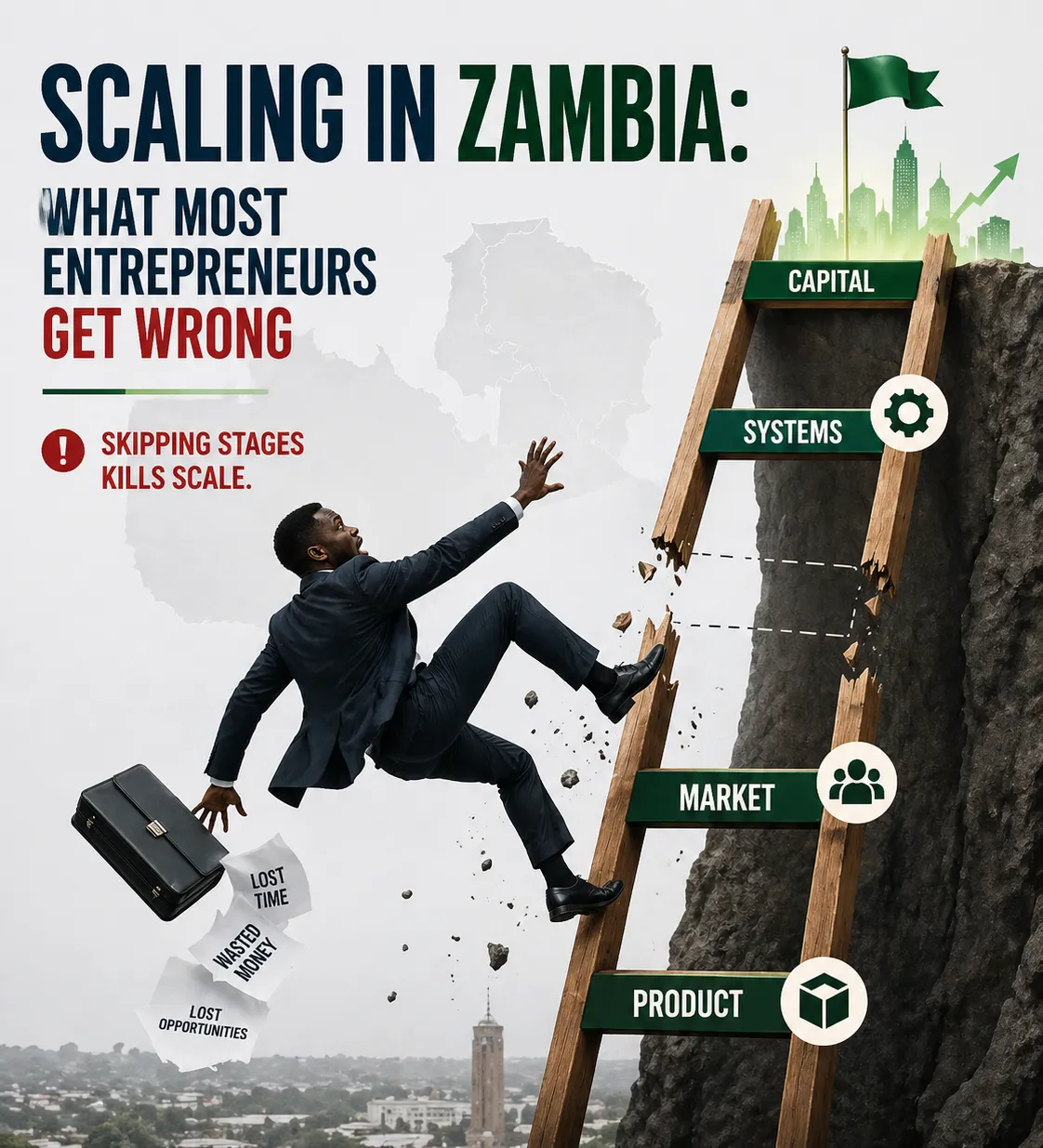
.png)

Introduction
In Zambia’s evolving business landscape, the gap between SMEs that scale successfully and those that remain stagnant is widening. Both groups often start with similar conditions, limited capital, strong ambition, and early-stage market traction. Yet over time, their trajectories diverge sharply.
The difference is rarely about opportunity. It is about structure, discipline, and adaptability in how businesses are built and managed.
Understanding this divide is critical for entrepreneurs, investors, and policymakers seeking to unlock SME-led growth in Zambia.
1. Scaling SMEs Build Systems, Stuck SMEs Rely on People
One of the most defining differences is operational structure.
Scaling SMEs:
- Develop standard operating procedures (SOPs)
- Automate or systemize repetitive tasks
- Reduce dependency on the founder
Stuck SMEs:
- Depend heavily on the owner for decisions
- Lack documented processes
- Operate informally
Without systems, growth simply creates more chaos instead of capacity.
2. Financial Discipline Separates Growth from Stagnation
Access to revenue does not guarantee scalability. Financial management determines sustainability.
Scaling SMEs:
- Maintain proper financial records
- Separate business and personal finances
- Use forecasting and budgeting tools
- Track unit economics
Stuck SMEs:
- Operate with informal bookkeeping
- Lack financial visibility
- Make decisions based on cash availability rather than data
Poor financial structure makes it impossible to attract investors or secure financing.
3. Capital Strategy Is a Major Differentiator
Scaling SMEs understand that growth requires structured capital, not just reinvestment.
They often combine:
- Retained earnings
- Structured loans
- Equity or partnership funding
Stuck SMEs typically rely only on:
- Daily cash flow
- Informal borrowing
- Short-term survival financing
This limits expansion capacity significantly.
4. Market Understanding Determines Expansion Success
Zambia is not a uniform market. Regional and sector differences matter.
Scaling SMEs:
- Adapt products to different regions
- Understand urban vs rural demand differences
- Adjust pricing and distribution strategies
Stuck SMEs:
- Apply a one-size-fits-all approach
- Fail to adjust to regional market dynamics
- Misread customer behaviour
Without market adaptation, expansion often fails.
5. Talent and Leadership Structure Matter
Scaling requires delegation.
Scaling SMEs:
- Build management layers
- Hire for specialized roles
- Invest in leadership development
Stuck SMEs:
- Founder remains central to all operations
- Limited delegation or trust in teams
- Weak organizational hierarchy
This creates a bottleneck that prevents growth beyond a certain point.
6. Access to Networks and Partnerships Drives Growth
In Zambia, business success is often influenced by networks.
Scaling SMEs tend to:
- Build strong supplier relationships
- Engage with industry associations
- Leverage strategic partnerships
Stuck SMEs often operate in isolation, limiting access to:
- Large contracts
- Financing opportunities
- Market intelligence
7. Infrastructure Awareness Shapes Expansion Strategy
Operational realities in Zambia, including logistics, energy, and transport, affect scalability.
Scaling SMEs:
- Design operations around infrastructure constraints
- Optimize supply chains
- Plan for energy and transport risks
Stuck SMEs:
- Expand without infrastructure planning
- Face repeated operational disruptions
- Absorb avoidable costs
8. Policy and Formalization Readiness
Businesses that scale are typically better aligned with formal systems.
Scaling SMEs:
- Comply with tax and regulatory systems
- Maintain proper licensing
- Position themselves for institutional partnerships
Stuck SMEs:
- Remain partially informal
- Avoid compliance systems
- Limit access to formal capital
As Zambia strengthens regulatory enforcement, formalization becomes a growth requirement, not just a legal one.
The Role of the Macroeconomic Environment
Zambia’s economic direction is being shaped by reforms supported through institutions such as the International Monetary Fund.
These reforms are gradually improving:
- Fiscal discipline
- Currency stability
- Investor confidence
However, transitional conditions also mean SMEs must operate with greater structure and resilience than before.
Why the Gap Is Widening
The divergence between scaling and stagnant SMEs is increasing due to:
- Rising competition in urban markets
- Greater access to structured capital for formal businesses
- Increased enforcement of compliance systems
- Digital transformation advantages for organized firms
In simple terms: the system is rewarding structure more than effort alone.
What Scaling SMEs Do Differently
Across sectors, successful SMEs in Zambia tend to:
- Build systems early
- Invest in financial discipline
- Expand cautiously into new regions
- Strengthen leadership teams
- Formalize operations before scaling aggressively
They treat growth as a managed process, not an outcome of demand.
The Hidden Truth: Scaling Is Not About Size, It Is About Structure
Many SMEs remain stuck not because the market is limited, but because their internal systems cannot support expansion.
The most important shift is mindset:
- From owner-driven to system-driven
- From informal to structured
- From reactive to planned
Conclusion
The difference between SMEs that scale in Zambia and those that remain stuck is not luck or market conditions, it is how the business is structured internally.
Scaling requires discipline, systems, and strategic thinking long before expansion begins. Without these foundations, growth becomes unsustainable.
Zambia’s SME sector holds significant potential, but only businesses that build the right structures will be able to unlock it.
Call to Action
If you are running or investing in an SME in Zambia, focus first on structure, not expansion.
Prioritize:
- Financial systems
- Operational processes
- Leadership development
- Strategic capital planning
Scaling is not a question of opportunity. It is a question of readiness.