.png)
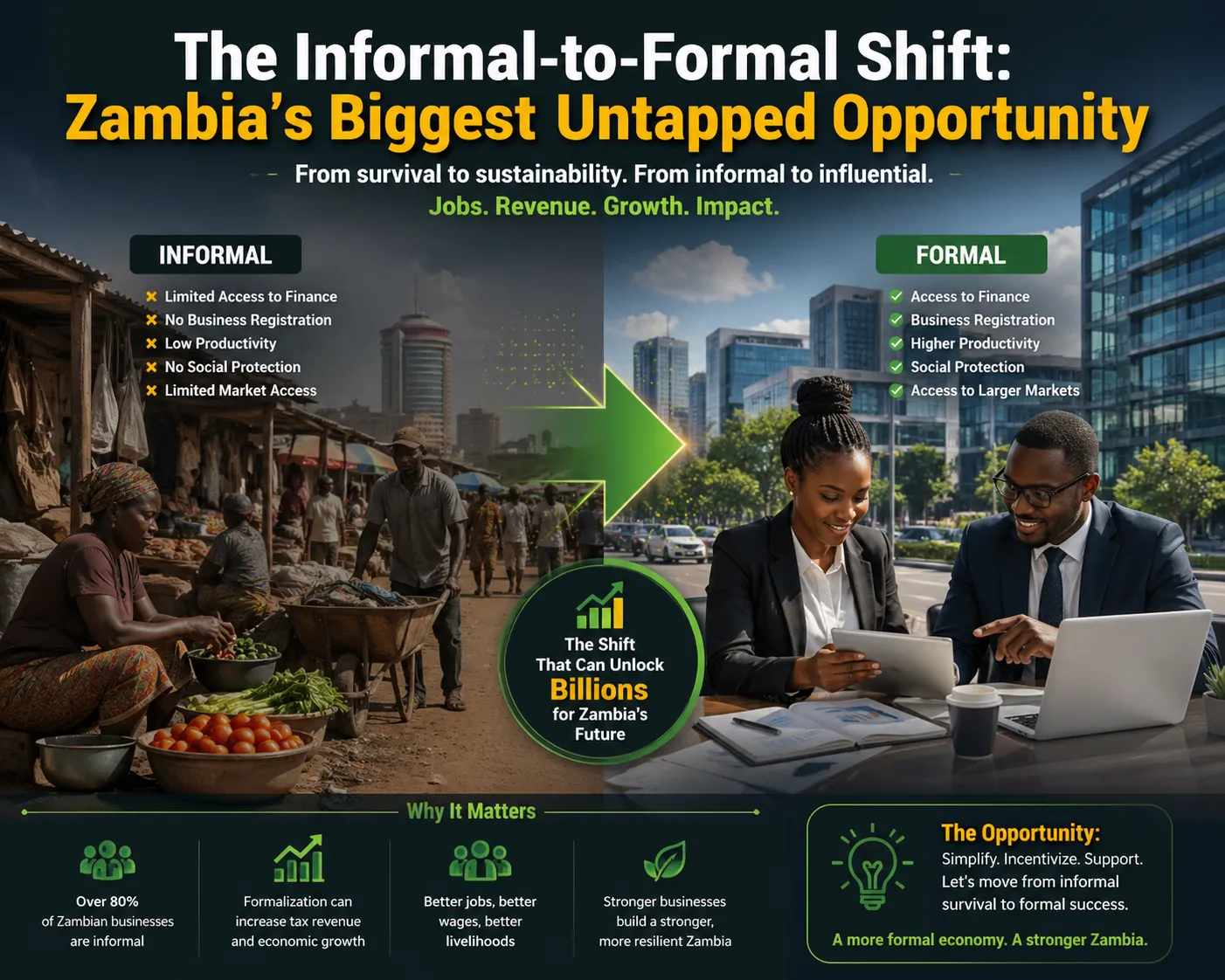
Introduction: The Economy Within the Economy
Across Zambia, a significant portion of economic activity happens outside the formal system.
From market traders to small-scale manufacturers and service providers, the informal sector is not marginal, it is foundational.
Yet despite its scale, it remains largely disconnected from:
- Formal financing systems
- Structured growth opportunities
- Regulatory frameworks
This gap is not just a challenge. It is one of Zambia’s largest untapped economic opportunities.
1. The Scale of Informality
Zambia’s informal economy is estimated to account for a substantial share of employment and economic activity.
It is characterized by:
- Cash-based transactions
- Limited record-keeping
- Unregistered businesses
- Minimal regulatory oversight
For many, informality is not a choice, it is the most accessible way to participate in the economy.
2. Why Businesses Stay Informal
The persistence of informality is driven by practical realities:
- Cost of compliance: Registration, taxes, and licensing can feel burdensome
- Complexity: Processes are often seen as difficult to navigate
- Limited perceived benefit: Formalization does not always translate into immediate advantages
- Survival mindset: Many businesses prioritize daily cash flow over long-term structuring
Until formalization clearly delivers value, many entrepreneurs see little reason to transition.
3. What Formalization Unlocks
When businesses move into the formal economy, the benefits can be significant:
- Access to bank financing and credit
- Eligibility for government and corporate contracts
- Ability to scale operations
- Improved credibility with partners and customers
Formalization transforms a business from survival-focused to growth-oriented.
4. The Missed Opportunity for the Economy
The impact is not limited to individual businesses.
At a national level, informal-to-formal transition can:
- Expand the tax base
- Improve economic data and planning
- Increase productivity
- Strengthen supply chains
Zambia is not lacking economic activity, it is lacking structured participation.
5. The Risk of Forced Formalization
Attempts to aggressively formalize businesses without addressing underlying constraints can backfire.
Risks include:
- Driving businesses further underground
- Reducing economic participation
- Increasing compliance avoidance
Formalization must be incentive-driven, not enforcement-driven.
6. What a Smarter Transition Looks Like
A successful shift requires aligning incentives with outcomes.
Key approaches include:
- Simplifying registration and compliance processes
- Offering tax incentives or phased compliance for new formal businesses
- Expanding access to affordable financing
- Providing business development support and education
The goal is to make formalization practically beneficial, not just legally required.
7. The Role of Financial Institutions and Private Sector
Banks, investors, and corporates have a role to play in accelerating the transition.
- Designing products tailored for small and transitioning businesses
- Creating supply chain opportunities for formalized SMEs
- Supporting capacity building and financial literacy
Formalization becomes more attractive when it is linked to real economic opportunity.
8. Technology as an Enabler
Digital tools are lowering barriers to entry into the formal economy.
- Mobile money platforms
- Digital bookkeeping solutions
- Online registration systems
These tools allow businesses to gradually build structure without large upfront costs.
Technology is turning formalization into a step-by-step process, rather than a single leap.
9. A Long-Term Structural Shift
The transition from informal to formal is not immediate.
It requires:
- Policy consistency
- Institutional support
- Cultural and mindset shifts among entrepreneurs
But over time, it can redefine how business operates in Zambia—moving from fragmented activity to coordinated economic growth.
Conclusion: Opportunity in Transition
Zambia’s informal economy is often viewed as a limitation.
In reality, it represents one of the country’s greatest opportunities.
The businesses already exist. The activity is already happening.
What is missing is structure.
Unlocking that structure, carefully and strategically, can transform both individual enterprises and the broader economy of Zambia.
Call to Action
Formalization is not just a regulatory step, it is a pathway to growth.
Entrepreneurs should evaluate how transitioning into the formal economy can unlock financing, partnerships, and scalability.
Policymakers and private sector players must focus on creating systems that make formalization practical and rewarding.
Build structure. Unlock access. Scale sustainably in Zambia.