.png)
Introduction
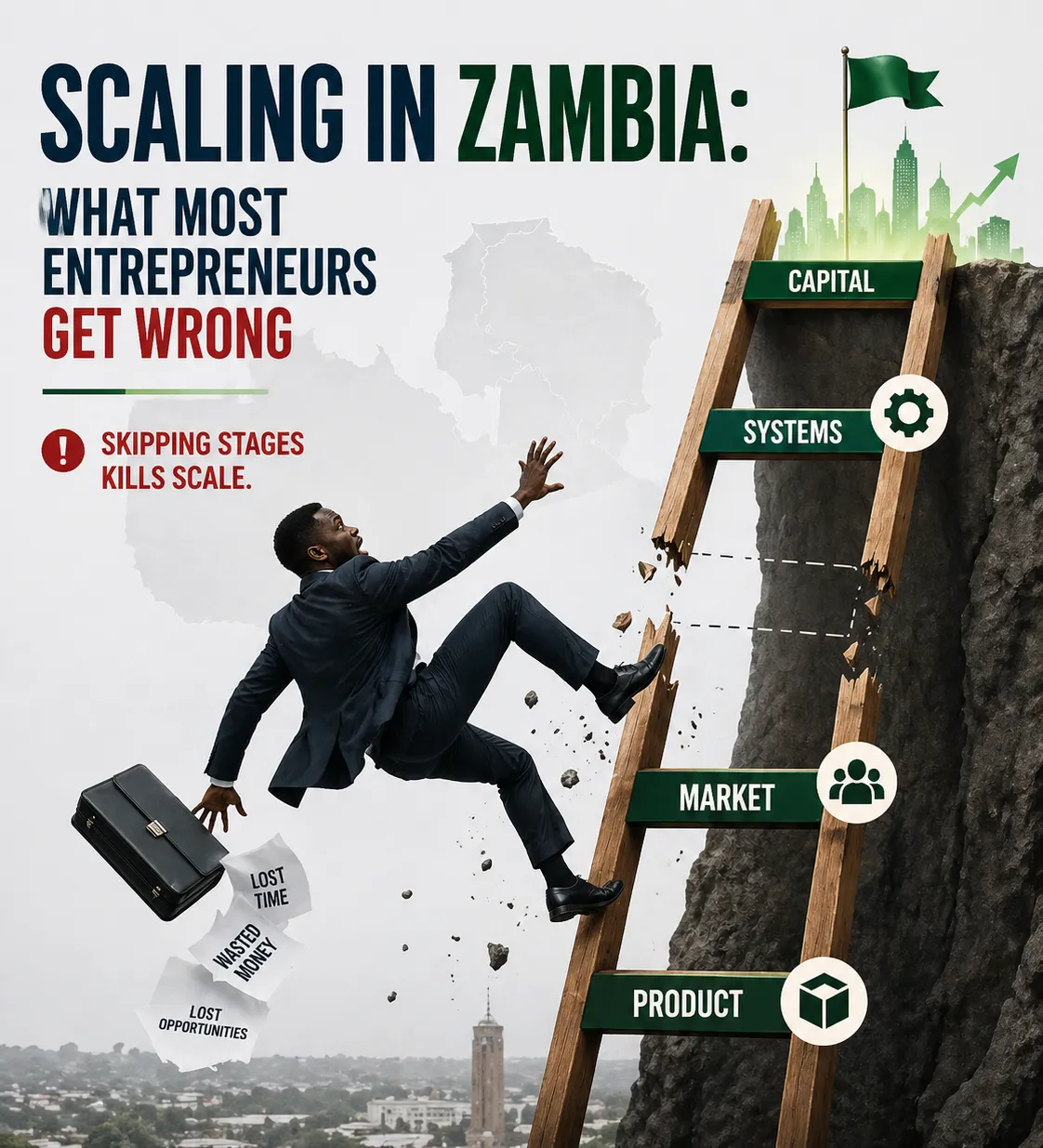
Starting a business in Zambia is relatively straightforward compared to scaling one. Many entrepreneurs enter the market with strong ideas, early traction, and growing customer demand, but struggle when it comes to expanding beyond the initial phase.
The problem is not usually the business model itself. It is the assumptions entrepreneurs make about scale in an environment where infrastructure, capital access, and operational systems behave very differently from mature markets.
Scaling in Zambia requires a different mindset, one that prioritizes structure, resilience, and market realism over rapid expansion.
Mistake 1: Confusing Demand Growth with Scalable Systems
Many entrepreneurs assume that increasing demand automatically means a business is ready to scale. In reality, demand growth often exposes operational weaknesses.
Common issues include:
- Inconsistent supply chains
- Weak inventory management
- Limited production capacity
- Informal operational systems
Without structured systems, growth becomes instability rather than expansion.
Mistake 2: Underestimating Infrastructure Constraints
Scaling in Zambia is heavily influenced by infrastructure realities, including:
- Electricity reliability issues
- Transport and logistics inefficiencies
- Limited warehousing capacity in some regions
- Uneven digital infrastructure
These constraints directly affect:
- Delivery timelines
- Cost structures
- Customer satisfaction
Entrepreneurs who ignore infrastructure realities often scale too fast for their operational base.
Mistake 3: Expanding Geographically Too Early
Many businesses attempt to expand from Lusaka into multiple provinces too quickly.
However, Zambia’s regional markets are not uniform.
For example:
- Lusaka: service-driven, competitive, urban demand
- Copperbelt: industrial and mining-linked economy
- Southern and Eastern regions: agriculture-driven cycles
Scaling without understanding these differences leads to:
- Misaligned product-market fit
- Increased operational complexity
- Higher failure rates in new locations
Mistake 4: Ignoring Capital Structure Limitations
Scaling requires capital, but not all capital is equal.
Many entrepreneurs rely heavily on:
- Short-term loans
- Informal funding sources
- Reinvested cash flow alone
This creates fragility during expansion phases.
More structured approaches, such as blended finance or investor partnerships, are often underutilized in Zambia’s SME ecosystem.
Mistake 5: Weak Financial Systems and Informality
A major barrier to scaling is the lack of formal financial infrastructure within businesses.
Common issues include:
- Poor bookkeeping systems
- Lack of audited financials
- Mixing personal and business finances
- Limited financial forecasting
Without strong financial systems, businesses struggle to:
- Attract investors
- Secure loans
- Manage expansion risk
Mistake 6: Hiring for Operations, Not for Scale
Many SMEs hire staff based on immediate operational needs rather than long-term scalability.
This leads to:
- Lack of middle management
- Over-centralized decision-making
- Founder dependency
Scaling requires shifting from “doing everything” to building systems that others can execute.
Mistake 7: Ignoring Market Fragmentation
Zambia is not a single unified consumer market.
Differences exist in:
- Income levels
- Consumption patterns
- Access to services
- Urban vs rural behaviour
Businesses that scale successfully adapt their models to these variations instead of assuming uniform demand.
Mistake 8: Expanding Before Achieving Operational Stability
One of the most critical mistakes is scaling before achieving internal stability.
Signs of premature scaling include:
- Unstable cash flow
- High customer complaints
- Inconsistent product quality
- Operational bottlenecks
Scaling amplifies both strengths and weaknesses, unresolved internal issues become magnified at scale.
What Successful Scaling in Zambia Actually Looks Like
Businesses that scale successfully tend to follow a different approach:
1. System Before Expansion
They build:
- Standard operating procedures
- Reliable supply chains
- Financial controls
before expanding geographically.
2. Controlled Geographic Expansion
Instead of rapid expansion, they:
- Test new regions gradually
- Adapt offerings per region
- Build localized partnerships
3. Capital Strategy Alignment
They combine:
- Reinvested profits
- Structured external capital
- Strategic partnerships
rather than relying on a single funding source.
4. Strong Local Networks
Scaling is supported by:
- Regional distributors
- Local suppliers
- Operational partners
The Role of the Macroeconomic Environment
Zambia’s evolving economic environment also shapes scaling dynamics.
Reform efforts supported by institutions such as the International Monetary Fund are gradually improving:
- Macroeconomic stability
- Policy predictability
- Investment confidence
However, transitional conditions mean businesses must still operate with flexibility and resilience.
Sector Differences in Scaling Potential
Retail and Consumer Goods
- High competition
- Requires strong logistics systems
- Sensitive to pricing pressures
Agriculture and Agro-Processing
- Strong scaling potential
- Seasonal variability impacts growth cycles
- Requires supply chain coordination
Manufacturing
- Capital intensive scaling
- Infrastructure dependency
- Benefits from economies of scale
Services and Digital Businesses
- Faster scaling potential
- Lower physical infrastructure constraints
- Highly dependent on talent availability
The Real Scaling Constraint in Zambia: Systems, Not Ideas
Most businesses do not fail because the idea is weak.
They fail because:
- Systems do not scale
- Operations are not standardized
- Capital structures are weak
- Expansion is not strategically planned
Scaling is fundamentally a systems problem, not an ambition problem.
Conclusion
Scaling in Zambia is less about speed and more about structure.
Entrepreneurs who succeed are those who:
- Build systems before expanding
- Understand regional market differences
- Strengthen financial and operational foundations
- Scale deliberately, not reactively
In this environment, sustainable growth is earned through discipline, not demand.
Call to Action
If you are planning to scale a business in Zambia, focus first on structure—not expansion.
Prioritize:
- Operational systems
- Financial discipline
- Controlled geographic growth
Scaling is not about doing more it is about doing better, consistently, across markets.