.png)

Zambia Is Open for Capital, But Only for Those Who Structure It Right
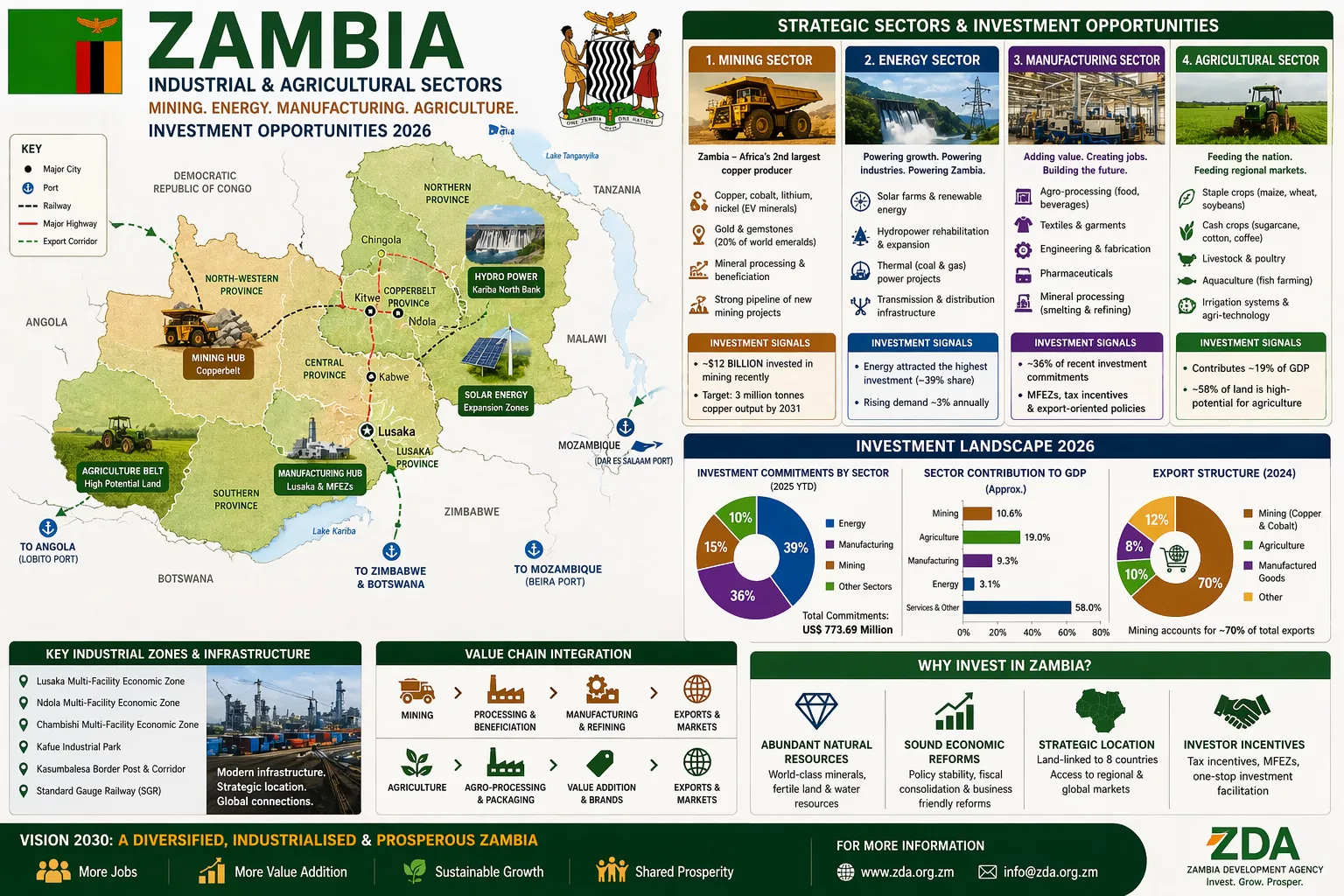
Zambia is rapidly positioning itself as one of Southern Africa’s most strategically important investment destinations. With a stable political environment, vast natural resources, and an aggressive push toward industrialization, the country is actively inviting foreign and diaspora capital.
But beneath this opportunity lies a critical reality:
Zambia is not an informal-entry market. It is a structure-sensitive investment jurisdiction.
This means that two investors can enter the same sector with the same capital and achieve completely different outcomes depending on how they structure their investment.
One investor accesses tax holiday, import duty exemptions, and regulatory support. The other faces full tax exposure, compliance delays, and missed incentive windows.
In Zambia, structure is not administrative, it is financial strategy.
Why Zambia Is Attracting Global and Regional Investors
Zambia’s rising investment profile is driven by a combination of geography, resources, and policy direction.
The country sits at the centre of Southern Africa’s trade ecosystem, linking the mineral-rich Democratic Republic of Congo to key regional markets such as South Africa, Botswana, Namibia, and Tanzania. This makes it a natural logistics and trade corridor.
Economically, Zambia is heavily resource-based. Copper remains its dominant export, but cobalt, manganese, agriculture, energy, and manufacturing are increasingly important growth sectors.
Government policy has also shifted toward private-sector-led development. Public-private partnerships are expanding, energy liberalization is accelerating, and industrialization is now a central economic priority.
The Zambia Development Agency (ZDA) plays a critical role in shaping investment inflows through structured incentive frameworks designed to attract long-term capital.
The Core Reality: Zambia Does Not Reward Poor Structuring
One of the biggest misconceptions among foreign investors is that company registration equals market readiness.
In Zambia, that assumption leads to costly mistakes.
The system is designed so that incentives and benefits are not automatically granted. They are triggered through correct legal and financial structuring.
Without proper structuring, investors often experience:
- Loss of eligibility for tax incentives
- Full corporate tax exposure
- Missed customs duty exemptions
- Delayed regulatory approvals
- Inefficient capital deployment
In simple terms, Zambia does not block investment, but it filters who benefits from it.
What Proper Structuring Actually Means in Zambia
Investment structuring in Zambia goes far beyond incorporation. It is a multi-layered framework that aligns legal identity, tax planning, regulatory engagement, and operational design.
The first decision is entity selection. Investors typically choose between a private limited company, a foreign branch, or a joint venture structure. Each option has different implications for tax treatment, liability exposure, and operational flexibility.
The second layer involves engagement with the Zambia Development Agency. ZDA approval is often the gateway to tax holidays, duty exemptions, and priority sector classification. Without it, investors are treated as standard taxable entities.
The third layer is sector alignment. Zambia’s incentive system is heavily sector-based, with agriculture, manufacturing, energy, tourism, and infrastructure receiving preferential treatment. Misclassification can permanently reduce benefits.
The fourth layer is tax structuring. This includes corporate tax planning, VAT recovery strategies, withholding tax exposure, and cross-border repatriation mechanisms.
Zambia Development Agency Incentives: The Real Entry Gate
The Zambia Development Agency is the central institution governing investment incentives.
Qualified investors may access:
- Reduced or zero corporate tax in priority sectors for defined periods
- Import duty exemptions on capital equipment
- VAT deferment mechanisms
- Accelerated depreciation allowances
However, these incentives are not automatic.
They must be applied for early, supported with detailed investment plans, and aligned with sector-specific requirements.
Timing is critical. Once operations begin without proper approval, many incentives become permanently inaccessible.
Common Investor Mistakes in Zambia
Despite Zambia’s openness to investment, many investors repeatedly fall into avoidable traps.
One of the most common is entering the market with only a basic company registration and no structured investment plan. This results in a legally compliant but financially inefficient entity.
Another mistake is delaying engagement with ZDA until after operations have started, which often eliminates eligibility for key incentives.
Some investors also rely on offshore structures that are not aligned with Zambia’s tax residency framework, creating unnecessary regulatory friction.
Sector misclassification is another frequent issue, especially in agriculture and agro-processing, where tax treatment and incentive eligibility vary significantly.
Finally, weak governance structures, particularly lack of properly defined compliance roles, often lead to operational bottlenecks.
How Smart Investors Structure Entry into Zambia
Successful investors typically follow a structured, multi-layer entry strategy.
They begin with legal structuring, selecting the most appropriate entity based on sector, control requirements, and capital strategy.
Next is incentive alignment, where engagement with ZDA is prioritized before major capital deployment to secure tax and customs benefits.
Operational structuring follows, including banking relationships, payroll systems, licensing compliance, and supply chain integration.
Finally, exit and repatriation planning ensures that dividends, profits, and capital flows are optimized across borders while minimizing tax leakage.
High-Opportunity Sectors Where Structure Determines Outcome
In mining and critical minerals, Zambia remains one of Africa’s most strategically important jurisdictions. However, licensing requirements, environmental compliance, and capital intensity demand precise structuring.
In energy, particularly hydro and solar, long-term agreements and PPP frameworks require strong regulatory alignment to unlock incentives.
Agriculture and agro-processing present high growth potential but depend heavily on land access, export licensing, and VAT recovery systems.
Manufacturing and industrial development benefit from export processing zones and tax relief frameworks, but only when properly classified and approved.
Zambia vs Other African Investment Destinations
Compared to Rwanda, Zambia offers a larger resource base and higher incentive potential, though Rwanda may provide faster administrative processes.
Compared to South Africa, Zambia is less saturated and more incentive-driven, making it attractive for early-stage industrial expansion.
Compared to Mauritius, which is a financial structuring hub, Zambia is a real economy production hub focused on physical investment, extraction, and manufacturing.
Each jurisdiction plays a different strategic role, but Zambia stands out for resource-backed investment opportunities.
Conclusion
Zambia is open for capital, but it is not structurally neutral.
The country actively encourages foreign investment, yet channels benefits through structured legal, tax, and regulatory systems.
Investors who enter with proper structuring unlock incentives, reduce tax exposure, and gain operational efficiency. Those who do not often discover that opportunity was never absent, it was simply inaccessible without structure.
In Zambia, capital is welcome. But structure determines who actually benefits from it.
Call to Action
If you are considering investing in Zambia, your most important decision is not where to invest, but how to structure your entry.
A properly designed structure can determine:
- Your tax exposure
- Your eligibility for incentives
- Your ability to repatriate profits
- Your long-term scalability
Before deploying capital into Zambia, structure first.