.png)
Introduction: Capital Is Becoming Selective
In 2026, investors are no longer asking whether to invest in Southern Africa.
They are asking where to place capital for the best risk-adjusted returns.
The region offers a mix of mature markets, reform-driven economies, and high-risk, high-upside environments.
Within that mix, Zambia is quietly moving from a secondary option to a strategic allocation.
1. The Regional Investment Spectrum
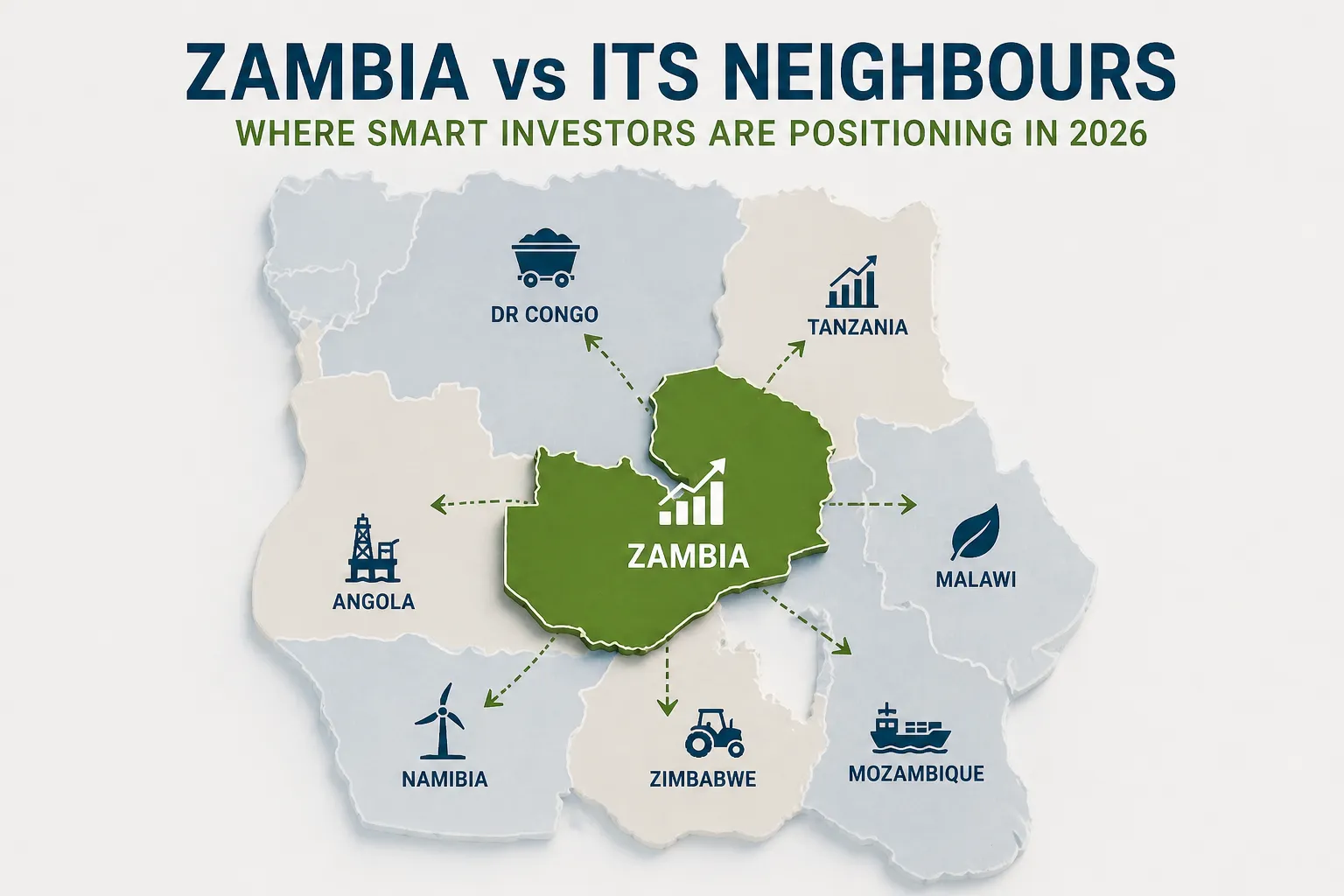
Southern Africa is not uniform. Each market offers a different balance of risk, stability, and opportunity:
- South Africa: Deep capital markets and infrastructure, but slower growth and structural constraints
- Botswana: Stability and governance, but limited market size
- Mozambique: High-potential energy projects with execution risks
- Zimbabwe: High-risk environment with undervalued opportunities
- Namibia: Emerging energy and green hydrogen play
Zambia sits between these extremes, not the most stable, but not the most volatile either.
2. Zambia’s Position: A Balanced Risk-Return Profile
Zambia is increasingly seen as a middle-ground market:
- More reform-oriented than higher-risk peers
- More undervalued than mature economies
- More accessible than some frontier markets
This balance is attractive to investors seeking upside without extreme volatility.
3. Debt Restructuring Changed the Narrative
Zambia’s restructuring process has had a regional impact on perception.
Compared to peers facing ongoing fiscal pressure, Zambia has:
- Taken visible steps toward resolving debt challenges
- Re-engaged with international partners
- Created a clearer investment outlook
This does not eliminate risk, but it makes it more predictable, which is critical for long-term capital.
4. Resource Advantage: Competing in a Global Market
Zambia’s copper sector is a key differentiator.
- Rising global demand supports long-term investment
- The country is positioned within the broader battery minerals ecosystem
- Proximity to the Democratic Republic of the Congo strengthens supply chain relevance
Compared to neighbours without similar resource scale, Zambia offers direct exposure to global commodity demand.
5. Where Other Markets Compete More Strongly
Zambia does not lead in every category.
- South Africa remains dominant in financial markets and infrastructure
- Botswana offers stronger institutional stability
- Namibia is emerging quickly in energy transition sectors
Investors are not choosing Zambia instead of these markets—they are allocating alongside them, depending on strategy.
6. Infrastructure and Energy: A Shared Regional Constraint
Many Southern African markets face similar challenges:
- Power shortages
- Logistics inefficiencies
- Infrastructure gaps
In Zambia, these constraints are particularly visible—but they also create investment entry points, especially in energy and logistics.
7. Capital Is Moving Toward Strategic Positioning
Investor behaviour is shifting from broad exposure to targeted plays.
- Mature markets attract institutional and low-risk capital
- High-risk markets attract opportunistic investors
- Mid-tier markets like Zambia attract strategic, long-term capital
This is where Zambia’s positioning becomes relevant, it fits the profile of investors willing to build, not just trade.
8. Why Zambia Is Gaining Attention in 2026
Several factors are converging:
- Improved macroeconomic direction following debt restructuring
- Strong long-term demand for copper
- Increasing relevance in regional supply chains
- Undervalued entry points across sectors
Individually, these are not unique. Together, they create a compelling investment case.
9. The Risk Factor Remains Real
Zambia still faces:
- Currency volatility
- Energy constraints
- Execution challenges in large-scale projects
However, compared to some regional peers, these risks are increasingly understood and manageable.
Conclusion: Not the Obvious Choice, But a Strategic One
Zambia is not the most obvious destination for capital in Southern Africa.
That is precisely why it is attracting attention.
- It offers growth potential without extreme instability
- It provides access to globally relevant resources
- It sits within a region that is becoming more interconnected
For smart investors, Zambia is not a replacement for other markets, it is a complementary, strategic position within a broader regional portfolio.
Call to Action
Investment in Southern Africa requires selective positioning and a clear understanding of each market’s strengths and risks.
Assess how Zambia fits within your broader strategy, particularly in sectors linked to resources, infrastructure, and regional trade.
Engage with local expertise, structure investments carefully, and position early in Zambia.
Allocate strategically. Manage risk deliberately. Capture long-term value.